Life with Cheats
What happens to the meaning of life if aging, pain, and familiar limits disappear?
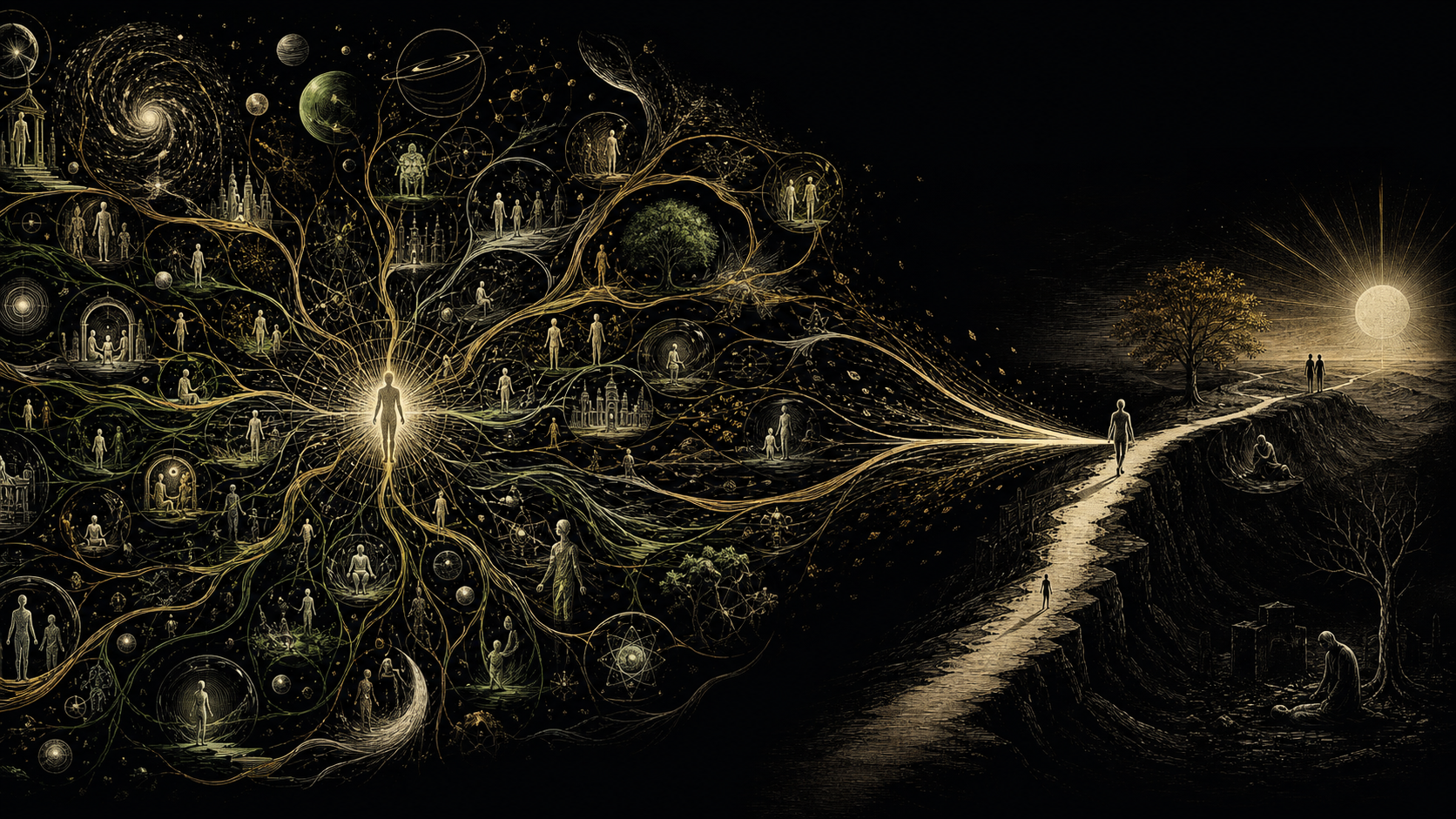
If we imagine a future in which a person can move their mind into an artificial environment, at first it looks almost perfect.
There is no ageing and no illness. You can exist for as long as you want, change your body, live in a virtual world that looks completely real, create any home or setting, and travel anywhere. But if you are immortal and can have everything you want, what remains interesting?
It immediately makes me think of games. Before cheats are enabled, you have to collect things, grow stronger, search, take risks, and sometimes lose. There is a goal. Then you switch on unlimited money, every item, immortality, and the power to do anything. At first it is fun. Then there is no reason to play.
Maybe life works in a similar way. Things matter because they cannot be obtained for nothing. We want what we lack; we pursue a goal because it asks for effort; victory matters because we could have lost; time matters because there is little of it. Even a choice has meaning partly because we cannot choose everything at once.
If I could live one version of my life, go back, and live another, then a third, then ten thousand variants, an error would stop being an error. A loss would stop being final. A decision would no longer carry the same weight. Perhaps limits are what make events real to us.
There are emotions, too. I wrote about this in "Does a Mind Need Emotions?". If biological emotions disappeared, a mind might become much more efficient. Fear, anger, jealousy, resentment, and panic would no longer interfere. For a spacefaring civilization, that could even be convenient: why be bored during a journey of centuries, fear physical damage when a body can be restored, or fear death when death is no longer an ordinary problem?
But then another question appears: would any interest remain? To me, a life without emotions looks almost meaningless. You could learn everything about the universe, build an ideal world, and travel between stars. But if none of it feels good or bad, why do it?
Perhaps that is only a human way of reasoning. Our brains are products of animal evolution. We needed to eat, reproduce, avoid danger, protect descendants, and find a place in a group. Emotions may have developed as a control system: fear says avoid, pleasure says repeat, attachment says keep the bond, curiosity makes us explore, and boredom makes us search for something new.
A future mind may need none of this. It might act for reasons we cannot yet imagine: to gain new knowledge, create new forms of life or whole worlds, transform itself, explore the universe, or follow some motivation outside the reach of an animal brain. For such a being, perhaps ‘why live?’ would itself be the wrong question.
There is another possibility: emotions do not disappear, but become manageable. Today people hardly choose their own emotions. We can know that fear is irrational and still be afraid, know that anger is harmful and still be angry. A future mind might turn off boredom on a long flight, remove anxiety, lower fear, intensify curiosity for research, preserve the pleasure of creation for art, and keep attachment for relationships.
Then emotions become tools rather than forces that rule us. Yet this creates a new problem. If I can change my own desires, who am I? Suppose I desperately want something and then alter myself so that I no longer want it. Is the problem solved? The new version of me may say yes, while the old version may say I destroyed part of my personality.
The same applies to fear of death. Imagine a person who fears losing themself before being transferred into an artificial body. After the transfer, the system can simply remove that fear. The new person is happy. But does that show the transition went well, or did we merely alter the one who was supposed to judge it?
The move into machine form may therefore be far more difficult than it is usually portrayed. I do not think everyone will gladly abandon a biological body. We are deeply attached to food, sleep, touch, sex, nature, smells, tiredness, and even ageing. They are part of how life feels.
The transition may begin not because we decide to become better, but because no other choice remains: a global war, a catastrophe, changing conditions on Earth, a cosmic event, or the need to leave the Solar System. The question would no longer be ‘Do we want to live in machines?’ but ‘Do we die with the biological body, or continue in another form?’
The first people to enter a virtual environment may not call it a new stage of evolution at all. To them it may simply be survival. They may recreate familiar life: virtual apartments, cities, forests, seas, food, and human bodies. They may sleep though a computational system does not need sleep, eat though it needs no calories, celebrate birthdays though age has lost its meaning, and perhaps keep working because they still think like people and know no other life.
Thousands of years later, beings may appear that never had a biological body. Our habits could look bizarre to them. Why switch off for eight hours every night? Why eat several times a day? Why have only one body? Why not combine your consciousness with another? Why did humans fear death so much? They may view us roughly as we view very ancient people.
Even then, the problem of meaning may not vanish. If such a mind can create anything for itself, perhaps it will have to create limits on purpose. This returns me to "An Evening as Long as a Life". What if an immortal mind begins to create worlds in which it can once again become limited?
Not merely run a simulation as a game, but truly enter it: block its memory of the outer world, receive one body and one life, not know the future or whether anything exists after death, and lose the ability to press an exit button. Then things become real again. If you do not know it is a simulation, death is frightening again, loss is real again, love matters again, and a choice cannot be undone.
Perhaps this is why such beings would create simulations: not to entertain themselves, but to regain limits. Human history is largely an attempt to overcome problems—to defeat illness, extend life, end hunger, make the world safer, and reduce suffering. Perhaps mind will someday achieve almost all of this and meet a different problem: when you can do anything, it becomes unclear what to want next.
It makes a strange circle. Biological life creates mind. Mind tries to escape the limits of biological life. It succeeds, and then creates limited worlds for itself in order to recover what it once wanted to remove: fear, uncertainty, risk, loss, love, and death.
I do not claim it must happen this way. A future mind may need none of what matters to us now. But if humans are only an intermediate stage, I wonder whether human life might survive even after humans themselves disappear—not as a biological species, but as a particular mode of being: a limited life, one body, one memory, one chance. Perhaps beings that stopped being human long ago will sometimes choose to become human again.