Not Toward the Stars, but Inward
Why an advanced civilization might abandon Galactic colonization in favor of virtual worlds
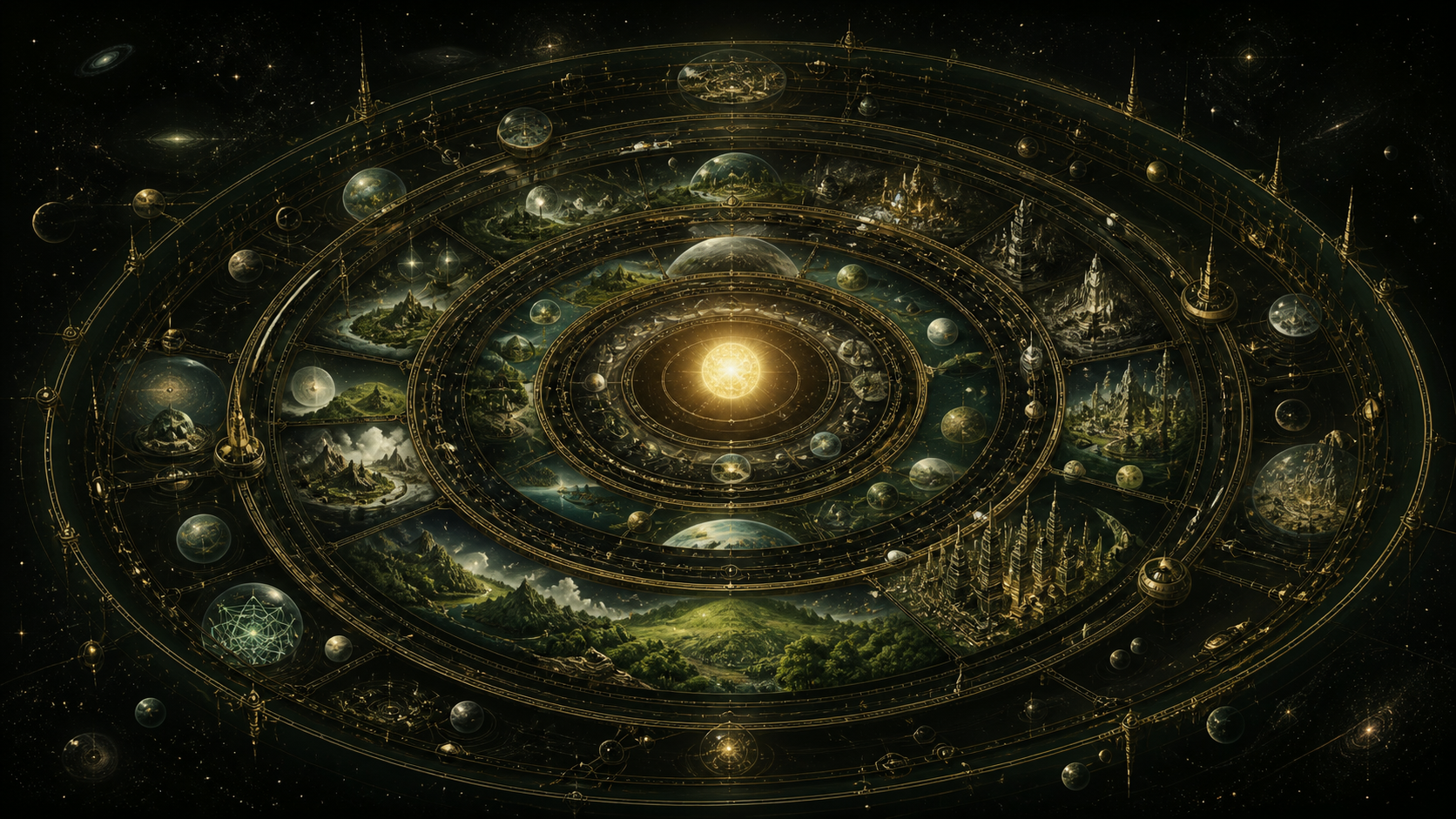
What if the path of an advanced civilization is not to conquer more and more space, but to create more and more space within computation?
When I imagine the distant future of humanity, the first picture comes to mind almost automatically.
First we explore the Moon and Mars.
Then other planets of the solar system.
Then we get to the neighboring stars.
In millions of years we will spread throughout the Galaxy.
And if we exist long enough, we will someday travel to other galaxies.
This results in a very clear development scale:
The more space a civilization occupies, the further it has advanced.
Perhaps this idea seems natural to us because all life known to us has developed in exactly this way.
Organisms reproduce and occupy new territories. Humans spread across continents. States expanded their borders. Cities grew. We were constantly searching for new lands, new resources, new spaces.
And now we just continue this line to the stars.
But I'm not sure that it will necessarily continue.
At some point, the mind may change so much that the very need to expand outward loses its former meaning.
Why do we need other planets anyway?
The main problem of space today is not even the distances.
The problem is ourselves.
Humans need oxygen. They need water. A certain temperature. Pressure. Food. Protection from radiation. Our bodies age, get sick, and are very poorly adapted to most places in the universe.
Essentially, wherever we fly, we have to carry a small piece of Earth with us.
I have already discussed this in the article “Human After Humanity”.
Perhaps humanity's true entry into space will not happen when we build the perfect ship, but when we cease to be completely dependent on the biological body.
Let's imagine a very distant future.
The mind exists on an artificial substrate.
The body can be replaced.
Memory can be stored and copied.
Diseases of a biological organism no longer determine life expectancy.
Such a being no longer needs to look for a second Earth.
Mars is not a new home for it.
Mars is just a few trillion tons of matter.
Asteroids are matter.
Gas giants are matter.
Even the star itself ultimately becomes, first and foremost, a huge source of energy.
And this is where the purpose of civilization can suddenly change.
The Star as a Source of Worlds
The sun emits a monstrous amount of energy every second.
We are now receiving an insignificant part of it.
But a civilization capable of constructing a huge number of energy and computing structures around a star could use a significant share of this flow.
What is usually mentioned here is a Dyson sphere or swarm—a multitude of structures around a star that collect its energy.
There is also a more fantastic idea: the Matrioshka Brain, a star system in which a significant share of the available matter is converted into gigantic computing infrastructure.
But I'm more interested not in how exactly such a machine will be designed.
Another question is more interesting.
Why would anyone need a computer that consumes the energy of an entire star?
Count even more numbers?
Predict the weather for a million years?
Solve all math problems?
Maybe.
But there is a much stranger option.
Use computation to create life itself.
Not biological life.
Life within the machine.
One kilometer of space can become larger than the Galaxy
Let's imagine two civilizations.
The first civilization took the path that we usually consider natural.
It spread throughout the Galaxy.
Colonized a million planets.
Each is home to a billion beings.
It turns out:
10¹⁵ lives.
An incredibly large civilization.
Now let's imagine the second one.
It barely went anywhere.
It remained near a single star.
It dismantled some of the planets and asteroids for materials, built a gigantic computing system, and learned to create full-fledged artificial worlds within it.
There are a billion intelligent beings in one.
Another contains ten billion more.
In the third, life develops in a way entirely unlike life on Earth.
In the fourth, intelligence emerges in an ocean.
In the fifth, there are entirely different forms of embodiment.
In the sixth, the history of civilization already lasts a million years.
And billions of such worlds operate simultaneously.
Physically, this civilization occupies only one star system.
But now a strange question arises.
Which of the two civilizations is actually larger?
The one that spread over a hundred thousand light years?
Or one within which more lives have been lived, more cultures have emerged, more stories have happened, and more subjective time has passed?
We are used to measuring the size of civilization in kilometers.
Then, perhaps, we will measure it in light years.
But for a sufficiently developed mind, such a unit may lose its meaning altogether.
Perhaps the development of a civilization should be measured not by the volume of space it occupies, but by the amount of internal reality it is capable of creating.
It Stops Expanding Outward and Starts Expanding Inward
This is the idea I like the most.
Up to a certain point, the development of life does require space.
More territory is needed.
More resources.
More planets.
But once sufficiently powerful computing becomes available, a completely new direction of growth emerges.
Growth no longer has to enlarge the external world.
It can enlarge the inner world.
Civilization stops expanding outward and begins to expand inward.
Moreover, the word “inside” here does not simply mean virtual reality like a modern game.
We are talking about full-fledged spaces of existence.
If consciousness can indeed be realized computationally—and we don't know that yet—then the inhabitants of such a world would not necessarily consider themselves virtual.
For them, their reality will be reality.
They will be born.
Be friends.
Afraid.
Study the structure of their world.
Build civilizations.
Argue about the origin of the universe.
Perhaps even create your own artificial worlds.
And if computational processes can be accelerated relative to the outside world, another oddity appears.
Externally, a hundred years passed near the star.
And within some systems, millions of years of history could have passed.
Then a small area of physical space really could contain more lived time than a vast part of the Galaxy.
Space is no longer the main resource
Today it seems obvious:
If humanity becomes cramped on Earth, we need to fly to Mars.
If the solar system becomes crowded, fly to another star.
But a virtual civilization may be unable to “run out of room” in the usual sense.
Its space is no longer determined by the size of the planet.
It is determined by computing power.
Add computing nodes, and new territories appear.
Add memory, and the world grows.
Add energy, and billions more processes can be launched.
Then a city-sized patch of matter could theoretically contain interior spaces through which its inhabitants travel throughout their lives.
And an object the size of a planet - the number of worlds that is difficult for the human consciousness to even imagine.
At some point, the concept of distance also changes.
To get to a new world, you don’t have to fly for ten thousand years.
You can simply switch the environment of existence.
Today, there are millions of light years between me and another galaxy.
And between two virtual universes of the future, there may physically be several meters of computing equipment.
But why then fly to other stars at all?
An obvious objection arises here.
If one star allows for the creation of a huge number of inner worlds, then a thousand stars will allow for the creation of even more.
It turns out that it is still beneficial for civilizations to spread throughout the Galaxy.
Maybe.
Therefore, I do not think that internal expansion will necessarily completely stop external expansion.
Rather, the meaning of external expansion will change.
Today we present:
We fly to another star to live there.
For such a civilization the logic may be different:
We are flying to another star to build another world-creating machine near it.
It is not even necessary to send billions of residents there.
Self-reproducing automatic systems are sufficient.
They reach the star.
They use local asteroids and planets.
They are building energy infrastructure.
The computers are launched.
And another huge inner world appears.
Then the next one.
And another.
Then external expansion becomes something like the growth of the root system.
But the main life does not take place in the roots.
Each captured star does not become a new territory of civilization as we understand it.
It becomes another source of inner reality.
Perhaps We Imagine Spacefaring Civilizations Incorrectly
It even changes how we can think about extraterrestrial intelligence.
We often imagine a very old civilization as a huge empire.
Millions of ships.
Thousands of inhabited planets.
Giant cities.
Constant movement across the Galaxy.
But a billion-year-old civilization could be completely different.
There are a huge number of incomprehensible structures near an ordinary star.
The planets are partially disassembled.
Most of the star's energy is intercepted.
No huge cities.
No billions of biological beings looking up at the sky.
Almost none of the activities we are used to.
From the outside, the system may appear strangely quiet.
Meanwhile, entire eras pass within it.
States arise and disappear.
New species evolve.
Minds experience millions of possible existences.
Works of art are created.
New laws are being discovered.
New worlds are launched within old ones.
There is one star outside.
Inside is a whole history, which in its scale has long surpassed the physical Galaxy.
Why create so many worlds?
And here this idea connects with what I have already written about earlier.
In the article “An Evening as Long as a Lifetime”, I asked myself: what would a nearly immortal posthuman mind do?
If diseases are conquered, the body can be changed, and material needs have almost disappeared, what remains?
Perhaps one of the main resources will be experience.
You can create worlds and enter them.
Forget external reality for a while.
Live a full life within.
And then come back.
But if it is already possible to create worlds, the next question arises:
Why only one?
In the article “If You Can Create Worlds, Why Create Only One?”, I considered the idea of a huge number of realities with different initial conditions, histories, and even laws of physics.
In this case, a giant computer near a star becomes more than just a machine.
It becomes something like a generator of ways to exist.
And then stellar energy turns into a very unusual resource.
Not just electricity.
Not just into computation.
But into lived time.
Into histories.
Into experiences.
Into new forms of intelligence.
Maybe the True Value of Energy Is Lived Time
Let's imagine a civilization that has learned to convert energy into computations very efficiently.
It then develops a strange economy.
We need energy to light our cities, move cars, smelt metal, and make things.
For it, energy can mean:
How many subjective years of existence can be created from this amount of energy?
One star burns for billions of years.
What if a significant portion of its energy is being used to run computing systems all this time?
Then the amount of history lived inside can be absolutely incredible.
Civilization may begin to optimize more than the production of goods.
More even than the production of energy.
It will optimize the production of existence.
How many lives can be lived?
How many new worlds to explore.
How many forms of intelligence can be created?
How much subjective time can be obtained from a kilogram of matter.
The very criterion of wealth is becoming different.
But all of this is still based on one huge “if”
There is an important boundary that must not be forgotten here.
We don't yet know whether it's even possible to create computational consciousness.
We don't know if it's possible to model a brain perfectly enough to actually have a subject inside that feels something.
We don't know whether it is possible to transfer a human personality to another carrier.
We don't know how fast such a system could work.
And of course, we don’t know how to build any kind of stellar computer yet.
Therefore, all this is not a forecast.
This is a thought experiment.
But individual parts of this picture do not require violation of known laws of nature.
The star is indeed a gigantic source of energy.
Computing does require power and heat removal.
Using a significant portion of the planetary system's matter to build a computing infrastructure does not in itself seem physically impossible.
The most unknown thing here is consciousness.
And it is precisely on the answer to the question about its nature that almost everything else depends.
If consciousness cannot be separated from concrete biology, this road may be a dead end.
But if consciousness is determined primarily by the organization of information and processes, the consequences are difficult to overestimate.
Then, for the first time in history, life will be able to stop waiting for the Universe to give it a new world.
It will be able to create worlds itself.
Maybe We Are Looking in the Wrong Direction
We have been looking at the stars for thousands of years.
At first they were considered to be lights on the celestial sphere.
Then they realized that these were different suns.
Then planets appeared around other stars.
And it became a natural dream to reach them someday.
I still like this dream.
But now another possibility seems interesting to me.
Perhaps the stars are not the final destinations of the mind's journey.
Maybe they are just huge energy nodes that will one day allow the creation of something much greater than just another colony on another planet.
Humanity can go into space.
Explore the solar system.
Reach other stars.
But after this, the direction of the mind's movement may change.
For the first billion years, life expanded into the space around itself.
The mind can open up a completely different space.
Internal.
And then the path of civilization will no longer look like this:
planet → star → galaxy → other galaxies.
Or rather, like this:
planet → mind → machine → star → billions of inner worlds.
Perhaps the most advanced civilization in the Universe will not be the one that has spread the farthest.
It may instead be the one that has learned to create the most reality from the small part of the Universe it already has.
It doesn't necessarily conquer space.
It transforms matter into new spaces.
And at some point it stops expanding outward.
Because there is much more space inside.