The Universe's Main Resource Is Not Energy but Differences
Why work, life, and intelligence depend on gradients, not energy alone
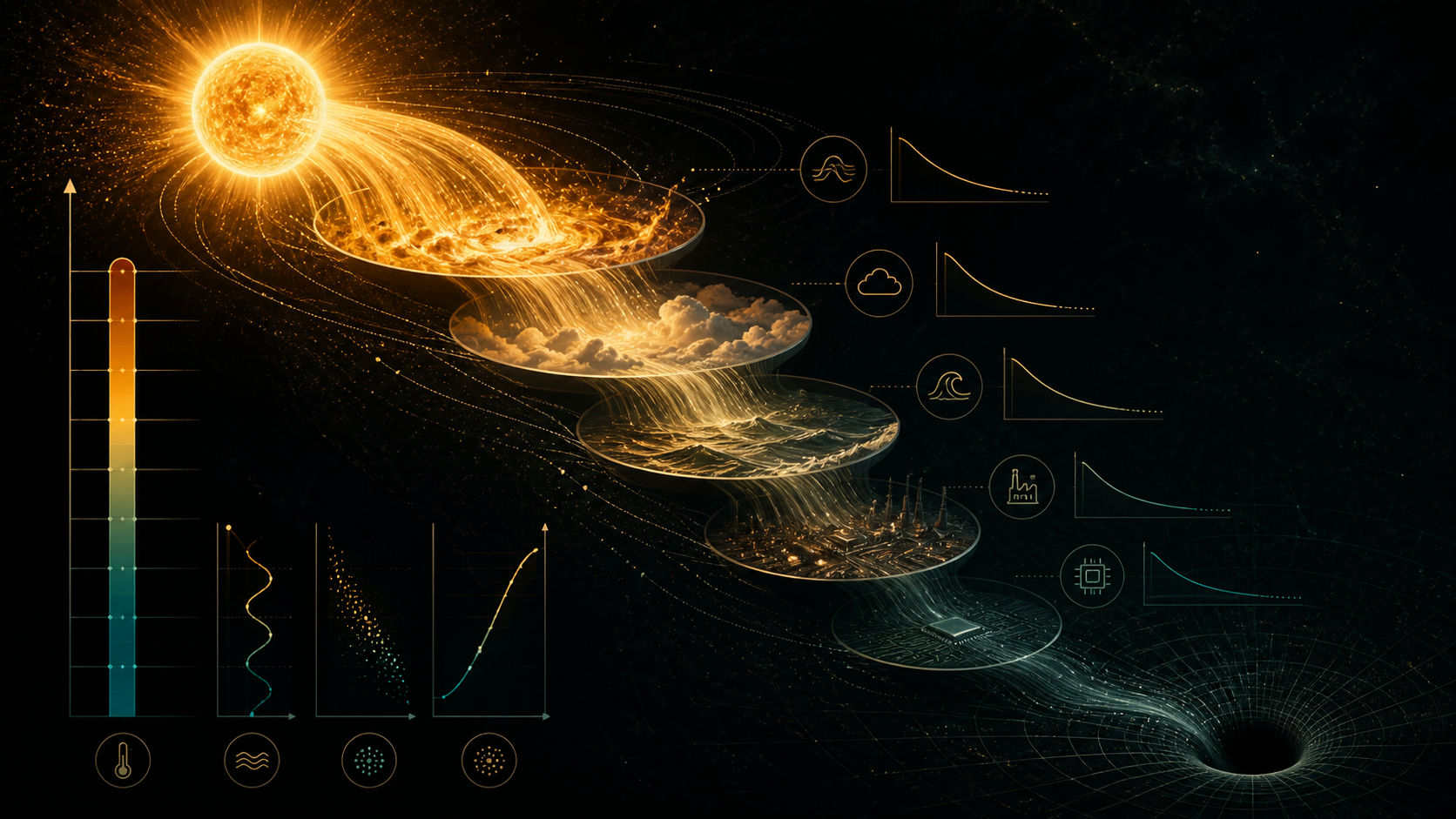
We are used to thinking that everything comes down to energy.
If there is energy, we can work, build, calculate, live. If there is no energy, everything ends.
But that is not quite right.
Energy in the universe may not disappear at all, while the possibility of doing anything with it still vanishes.
Because work needs more than energy.
It needs a difference.
The simplest analogy is a waterfall.
Water at the top has potential energy. It falls and turns a turbine. But after the turbine, the water has not disappeared. It still has mass, its molecules still move, and energy still exists.
The water is simply lower down.
Put another turbine farther down and you can get more work.
Then another one.
But once the water reaches sea level, its fall can no longer be used.
The water is still there.
What has disappeared is the difference in height.
Something very similar happens with heat.
A star is the top of the waterfall
The Sun has a surface temperature of about 5,800 K.
The space around us is much colder.
That difference is exactly what makes solar energy so useful.
We can receive hot radiation from a star, do work, and then release lower-quality energy as heat into a colder environment.
In other words, a civilization does not feed on a star's energy alone.
It uses an enormous temperature gradient:
hot star → cold space.
It is a kind of energy waterfall.
And the farther energy “falls” in temperature, the less useful work remains in it.
Why one supply of energy cannot be used forever
Imagine a computer of the future.
It receives 100 joules of energy and uses them for computation.
Afterwards, the energy has not disappeared.
Almost all of those 100 joules eventually become heat.
The obvious question follows:
why not collect that heat in a battery and use it again?
To a degree, you can.
If the computer is hot and its environment is cold, the temperature difference can again produce useful work.
But it is impossible to get all of it back.
Every cycle increases entropy.
Put simply, energy becomes more evenly distributed and less able to do work.
At some point the source temperature nearly matches the temperature of its surroundings.
And the energy waterfall ends.
That is why the intelligence of the future may have many levels
Now imagine a civilization that has learned to use energy almost perfectly.
The strangest choice would be to take energy from a star, perform one computation, and immediately dump the remaining heat into space or into a black hole.
That would be like building a dam one kilometre high and installing a turbine only at the very top.
It would be far more advantageous to use the flow several times.
For example:
star — 5,800 K
↓
energy-intensive manufacturing
↓
high-temperature computation
↓
cooler computational systems
↓
still cooler systems
↓
radiating the remaining heat into space
This produces a cascade.
Each next level uses what the previous level already considers waste.
In effect, we can imagine an entire intelligence made of computational layers at different temperatures.
The hottest levels work with the highest-quality energy.
Their waste heat becomes a resource for those below.
Only the final level releases the energy outward for good.
A black hole then becomes not a battery but a sewer
A black hole can absorb enormous amounts of energy.
It may therefore seem tempting to use it as a place where a civilization discards waste heat.
But sending energy there immediately means giving up the chance to use it further.
It is more logical to pass the energy through the entire cascade first.
To obtain the maximum possible computation from it.
And only then to dispose of the remainder.
In such a system, a black hole becomes neither the main source of energy nor even the main computer.
It may become the final receiver of waste.
Almost like a sewer for entropy.
Electricity works by the same principle
Here the waterfall analogy becomes even more interesting.
Electric current arises from a difference in electric potential.
If two points have the same potential, current has almost nowhere to flow.
In a battery, what matters is not merely the energy in the material.
What matters is the chemical difference between the states of the electrodes.
In the atmosphere, wind arises from differences in pressure and temperature.
Rivers flow because of differences in height.
A heat engine works because of a difference in temperature.
Living cells use differences in ion concentration on opposite sides of a membrane.
Even our bodies constantly maintain states far from equilibrium.
This suggests a general principle:
work is created not by the mere presence of energy, but by the possibility of moving from one state to another.
Life, too, exists because of differences
A living organism is a structure that continually maintains boundaries.
Inside a cell, the concentration of a substance is one thing.
Outside it, another.
Temperatures, chemical potentials, and electric charges are constantly different.
An organism spends energy precisely so that these differences do not disappear.
When a system reaches complete equilibrium, its processes stop.
In this sense, life is not merely a machine that consumes energy.
It is a machine that uses and maintains non-equilibrium.
The same may prove true of intelligence.
What the heat death of the universe would mean
The name makes it sound as though energy will one day run out.
But the idea of heat death is much stranger.
Energy may remain.
Matter may remain.
Space will remain.
But everything will gradually approach a state with almost no accessible gradients left.
There will not be enough hot and cold.
There will be no energetic “top” and “bottom.”
The waterfall will become a calm ocean.
And then extracting work becomes almost impossible.
That leads to an unexpected conclusion.
Perhaps the universe's main resource is not energy.
Its main resource is unevenness.
Differences in temperature.
Differences in pressure.
Differences in height.
Differences in electric and chemical potential.
While differences exist, energy can flow.
While energy flows, work can be done.
While work can be done, machines, life, and intelligence can exist.
And one day the universe may die not because nothing remains in it.
But because there is nowhere left for anything to fall.