When Does a Planet Begin to Think?
Could a global network develop into a single planetary intelligence?
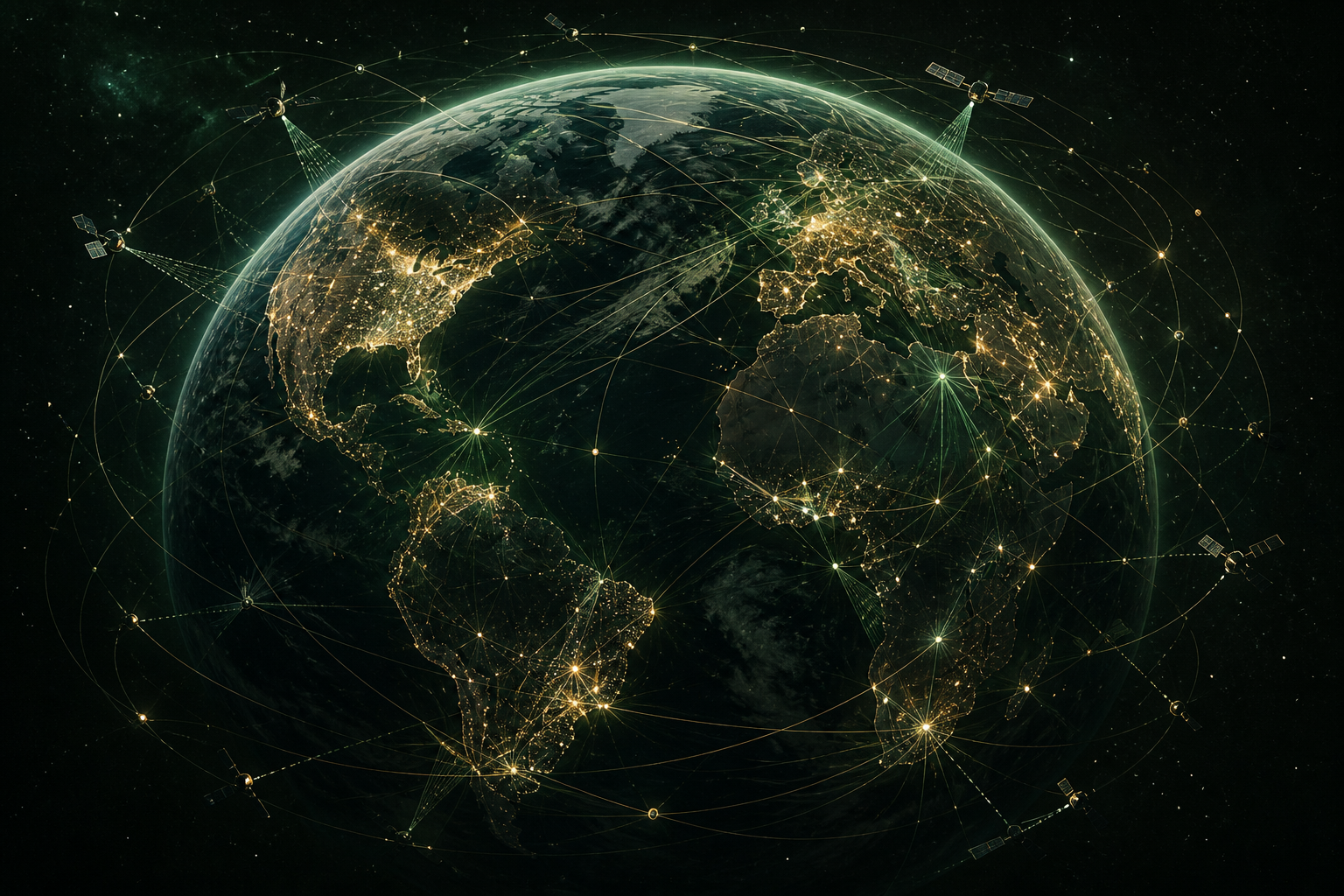
The Planetary Cognitive Integration Scale: From the Internet to Possible Planetary Intelligence
Abstract
Intelligence is typically viewed as a property of an individual organism or artificial computing system. However, collective problem solving, information storage, adaptation, and control can also arise in distributed systems consisting of a large number of relatively independent elements.
Modern civilization is gradually creating a global network connecting people, computers, artificial intelligence, satellites, sensors, databases, energy systems, transportation, and machines. Concepts of a "global brain," noosphere, and planetary intelligence already exist. In particular, Frank, Grinspoon, and Walker view planetary intelligence as collective knowledge operating on a planetary scale and integrated with the functioning of planetary systems.
This paper proposes an additional way to describe such a transition: the Planetary Cognitive Integration Scale (PCIS ) .****
PCIS divides the development of a global information system into six functional stages:
global connectivity → global perception and memory → integrated modeling → planetary agency → self-model and self-regulation → autonomous planetary intelligence.
The main criterion is not the size of the network or the number of calculations, but the emergence of new functions of the system as a whole.
Particular importance is attached to cognitive closure —the formation of a closed circuit:
perception → memory → model of the world → decision → action → change of the world → new perception.
Consciousness is deliberately not included in the scale. Even a system corresponding to the highest level of PCIS need not possess a unified subjective experience.
1. From Neuron to Planet
A single neuron in the human brain does not possess human intelligence.
It receives signals, changes its state and transmits signals to other cells.
Intelligence does not emerge within a single neuron, but at a different level of organization—as a result of the interaction of a huge number of elements.
This raises a more general question:
Does intelligence necessarily have to belong to a separate organism?
Modern biology increasingly views living systems as multiscale structures in which new capabilities emerge at various scales: from molecular networks and cells to tissues, organisms, and collectives. McMillen and Levin, for example, propose considering collective intelligence as a unifying principle for the study of problem solving at different levels of biological organization.
Evolution has repeatedly united previously relatively independent elements into systems of a new level.
Molecules formed cells.
Cells are multicellular organisms.
Individual organisms of some species have formed highly integrated colonies.
The study of major evolutionary transitions has long raised the question of how individual units come to function as parts of a larger whole.
Humanity may be creating another such level, but not exclusively through biological means.
Today, billions of people are constantly connected via technological communications channels. Satellites monitor the Earth. Sensors measure the state of the atmosphere, oceans, transportation, industry, and energy. Enormous computing systems store information and build models. Artificial intelligence is increasingly being used to process it.
We are used to perceiving all this as a set of different technologies.
But if you look at it as a single architecture, a different picture emerges:
sensors → communication network → memory → computation → decision making → physical actuators.
Functionally, this is already beginning to resemble some properties of the nervous system.
This does not mean that the Internet is the brain.
But the question arises:
At what point does the global network cease to be simply a means of communication and become a higher-level cognitive system?
2. Prior Approaches
The idea of planetary-scale intelligence has a long history.
The concepts of the noosphere assumed the emergence on Earth of a new level of organization associated with the intelligent activity of humanity.
Later, the idea of a " Global Brain" emerged . Heylighen and Lenartowicz define it as distributed intelligence arising from the interaction of human and technological agents via the internet.
In 2022, Adam Frank, David Grinspoon, and Sara Walker proposed that intelligence be viewed directly as a planetary-scale process.
They identified five properties associated with planetary intelligence:
- emergence;
- network dynamics;
- semantic information networks;
- complex adaptability;
- autopoiesis.
The authors also distinguish between an immature and mature biosphere, and then between an immature and mature technosphere. In their model, modern Earth corresponds to the immature technosphere: human technology is already significantly changing the planet's state, but these impacts have not yet formed a sustainable system for the self-sustaining nature of the entire "civilization + biosphere" complex.
PCIS does not attempt to replace this model.
She asks another question.
Not:
"What type of planet is this?"
A:
"What cognitive functions does the global system have at this stage?"
3. Defining the Planetary System
One of the main problems with such reasoning is the incorrect definition of the system boundary.
Planetary intelligence within the PCIS framework is not the Internet per se .
The Internet is only a communication layer.
The proposed system includes:
people + artificial intelligence systems + computers + communication networks + databases + sensors + satellites + energy infrastructure + transport + production systems + robots and other actuators.
In this case, the biosphere, atmosphere, oceans and other natural systems of the Earth can simultaneously act as:
- the environment in which this system exists;
- source of information;
- object of influence;
- part of global feedbacks.
This is an important distinction.
A critic might say:
"The Internet doesn't decide anything. People decide."
But a similar statement can be made about the brain:
"The brain doesn't decide anything. Neurons do."
The question is not whether the components remain active, independent elements.
The question is different:
Does behavior arise at the system-wide level that cannot be adequately described by just one of its elements?
It is precisely this transition that is of interest here.
4. Working definition of intelligence
For the purposes of this model, intelligence is proposed to be understood functionally.
Intelligence is the ability of a system to receive information about the world and itself, store it, integrate it with previous experience, build models of possible states, select actions, and change subsequent behavior based on the results of these actions.
This definition intentionally does not contain the words "neuron," "brain," or "biology."
The material from which the system is built is secondary here.
The organization of processes is of primary importance.
Thus, the presence of a global network does not in itself mean intelligence.
A sequence of functions is needed.
5. PCIS: Levels of Planetary Cognitive Integration
Level 0 - Local Intelligence
There are intelligent agents on the planet, but there is no permanent global information infrastructure between them.
Each individual or local group has knowledge, but much of the information cannot be quickly disseminated on a planetary scale.
Humanity has been in this state for most of its history.
Key feature:
Intelligence is present on the planet, but there is no planetary cognitive system yet.
Level 1 - Global Connectivity
At this stage, an infrastructure emerges that allows virtually any part of civilization to exchange information.
The telegraph, telephone, radio, satellite systems, and especially the Internet have gradually formed a communications network on a planetary scale.
Main property of level 1:
information begins to move between remote nodes much faster than civilization itself changes.
But such a network can still remain only a transmission channel.
If a billion computers can send messages, that doesn't mean that a billion computers form a single intelligence.
The analogy with the nervous system is limited here:
Conductivity already exists, but integrated global knowledge does not necessarily exist yet.
Level 2 — Planetary Sensing and Memory
The next transition occurs when the global network begins to not only transmit messages between people, but also continuously collect information about the state of the planet itself.
Appears:
satellites;
meteorological stations;
ocean buoys;
cameras;
microphones;
radar systems;
telescopes;
seismographs;
industrial sensors;
transport telemetry;
environmental monitoring;
medical and economic statistics.
A functional analogue of a distributed sensory system is being formed .
At the same time, data centers, archives and databases create a global external memory.
An event may end, but its information trace remains available to other parts of the system.
A fundamentally new structure emerges:
world → global sensors → network → memory.
Humanity today is already to a large extent at this level.
Level 3 - Planetary Modeling
But feeling and remembering is not enough.
The next level begins when data from multiple independent sources is systematically combined to build models of the world.
The system gains the ability to answer not only the question:
"What's happening?"
but also:
"Why is this happening?"
"What happens next?"
"What happens if you change a certain parameter?"
At this level, global climate models, atmospheric models, epidemiological forecasts, economic and infrastructure network analysis, and other forms of large-scale computing arise.
The development of artificial intelligence can significantly enhance this transition.
However, the main thing here is not the existence of AI itself.
The main thing is integration .
A million independent intelligent systems do not necessarily constitute a global intelligence.
A system becomes interesting when the interaction of its components creates a cognitive result that is not present in each of the components individually.
Research into collective intelligence shows that network structure can indeed both improve and hinder collective problem-solving. Simply increasing the number of connected participants does not guarantee increased intelligence across the entire system.
Level 4 - Planetary Agency
This is where one of the most important PCIS transitions occurs.
The system no longer just observes and predicts.
She begins to act .
A full cycle occurs:
perception → memory → model → decision → action → changing the world → new perception.
This cycle is proposed to be called cognitive closure within the framework of the model .
Let's look at a simple example.
Satellite detects major forest fire.
At a lower level, information is transmitted to a person.
A person analyzes it.
A person makes a decision.
The man dispatches the fire brigade.
The global network is a tool here.
Now let's imagine a different architecture.
Satellite system detects fire.
AI combines satellite data with wind forecasts, forest conditions, road networks, and available resources.
The system calculates the development of a fire.
Automatically redirects drones.
Changes transport routes.
Manages fire safety infrastructure.
Observes the consequences through sensors.
Recalculates the model.
Changes actions.
Now there is a closed loop:
Earth → system → Earth.
Functionally, such architecture is much closer to an agent.
6. Cognitive closure as a critical boundary
Perhaps it is precisely this feedback loop that is one of the most important transitions between the global computing system and the planetary agent.
A living organism has a constant loop:
sensation → internal state → action → result → new sensation.
If this loop is broken, the intellect ceases to effectively control the body.
A similar criterion can be applied to the technosphere.
The Internet without actuators primarily transmits information.
Internet + AI is able to interpret it.
The Internet + AI + global sensors + autonomous infrastructure already have the potential to form stable cognitive loops.
This is why robotics, autonomous vehicles, controlled energy grids, and automated industry may prove to be more than just another technology.
They create the engine layer of the global information system .
Level 5 – Self-model and planetary self-regulation
Higher intelligence must be able to model not only the surrounding world.
He must take himself into account .
The human brain constantly receives information not only from the external senses.
It also monitors body temperature, energy status, blood pressure, blood gases, tissue damage and a host of other internal parameters.
Functionally, the organism has a model of its own state.
For the global system, the analogy becomes observation of:
state of energy;
communication networks;
computing infrastructure;
resource reserves;
the state of the economy;
production chains;
the state of the human population;
biosphere;
climate;
the impact of the technosphere itself on the environment.
A fundamentally new question arises:
"What's happening to me as a system?"
If a particular action brings local benefit but destroys the long-term conditions of existence of the entire system, an advanced system should be able to detect this.
And then change your own behavior.
It's not just intelligence anymore.
This is the beginning of homeostasis on a planetary scale .
Here, PCIS intersects with Frank, Grinspoon, and Walker's concept of a mature technosphere. In their model, a mature technosphere should form feedback loops with the biosphere and geophysical systems that support the stability of the entire interconnected complex.
Level 6 - Autonomous Planetary Intelligence
At the last level under consideration, the system has more than just memory, prediction and feedback.
She becomes a stable agent.
To do this, you need at least:
- continuous model of the surrounding world;
- eigenstate model;
- ability to detect problems without an external operator;
- ability to form subgoals;
- ability to allocate resources;
- the ability to choose between different strategies;
- ability to assess consequences;
- the ability to rebuild one's own architecture;
- resistance to damage of individual elements;
- the ability to maintain one's own long-term existence.
The most unusual property of such a system is that its intelligence may not be located anywhere in particular .
It will not be possible to open a specific server and say:
"This is where planetary intelligence resides."
It will be distributed among a huge number of processes.
Just as human intelligence cannot be localized in one single neuron.
People will not necessarily disappear or lose their individual intelligence.
A neuron remains a cell while inside the brain.
A person can theoretically also remain an independent subject and at the same time be an element of a higher-level system.
7. Six levels in brief
| Level | Primary function | Functional analogue |
|---|---|---|
| 0 | Local intelligent agents | Individual elements |
| 1 | Global information transfer | Conductive network |
| 2 | Sensing and memory | Sensory organs and memory |
| 3 | Integration and modelling | Cognitive processing |
| 4 | Closed loop of decision and action | Sensorimotor loop |
| 5 | Self-model and self-regulation | Interoception and homeostasis |
| 6 | Autonomous long-term agency | Integrated intelligent organism |
However, this table should not be understood as a rigid ladder.
A real planet can be simultaneously at different levels for different functions.
8. The Earth cannot simply be assigned one number
This is an important refinement of the model.
The modern Earth is not a homogeneous system.
In some areas, global integration is extremely high.
In others, it is almost absent.
Therefore, instead of stating:
"The earth is at level 2"
It is better to build a cognitive profile of the planet .
The state of the system can be represented as a vector:
P = (C, S, M, I, W, A, F, SM, G, AU)
Where:
- C — Connectivity: global connectivity;
- S — Sensing: coverage of sensory systems;
- M — Memory: capacity and availability of global memory;
- I — Integration: the ability to combine data from independent subsystems;
- W — World Modelling: the ability to build models of the world;
- A — Agency: the ability to transform decisions into physical actions;
- F — Feedback Closure: the degree to which the feedback loop is closed;
- SM — Self-Model: quality of the model of one’s own state;
- G — Goal Coherence: coherence among global goals;
- AU — Autonomy: autonomy of global governance.
For the modern Earth, we can tentatively assume:
C - very high;
S — high;
M — very high;
I — average;
W - average or high in certain areas;
A - fragmentary;
F — fragmentary;
SM - low or medium;
G — low;
AU - low.
Thus, it is more correct to describe modern civilization as a system that has confidently formed levels 1–2, is actively forming level 3, and is locally creating elements of level 4 , but does not yet represent a single planetary agent.
9. The Problem of a Shared Goal
Even if the entire Earth were covered with sensors, the internet, and artificial intelligence, it might still not be enough.
Let there be ten billion intelligent agents.
Some want one thing.
Others are the opposite.
Companies compete.
States are in conflict.
Algorithms optimize different indicators.
People pursue billions of independent goals.
Such a system may have enormous computational power and yet lack unified agency .
Therefore, a separate parameter appears in PCIS:
Goal Coherence
Collective intelligence and a single subject are not the same thing.
An anthill is able to exhibit coordinated behavior because the local rules of its elements create a relatively stable function for the entire colony.
Humanity does not yet have this level of coordination.
Perhaps the global network will never become a single agent.
Instead, there may be multiple competing planetary-scale cognitive systems on Earth.
This is one of the open possibilities of the model.
10. How Fast Should Planetary Intelligence Think?
There is another reason why we may not notice the intelligence of systems at other scales.
We are accustomed to considering our own speed of thinking to be normal.
A person makes some decisions in seconds.
But why should this be a universal measure of intelligence?
Different systems have different characteristic cognitive cycle times .
Let's denote it:
τ is the cognitive timescale.
For the nervous system, some processes occur in milliseconds.
For a person, a complex decision can take hours or days.
For a society, changing beliefs can take decades.
For a civilization, a major decision can take generations to implement.
The planetary cognitive cycle could theoretically look like this:
climate change is detectable over the course of years;
↓
the global system builds a model;
↓
the energy sector has been undergoing restructuring for several years;
↓
after decades the results are visible;
↓
The next strategy is being adjusted.
To an individual, this seems incredibly slow.
But for a system that has existed for centuries, such a cycle may be normal.
And here a more general principle appears:
The absence of behavior on a human time scale does not prove the absence of information processing.
This is why comparisons with biological distributed networks, including mycelium, are interesting.
Slow signal transmission by itself does not tell us that the network is not processing anything.
The main thing is whether there is a causal sequence:
signal → change in internal state → change in future behavior.
11. Pathologies of planetary intelligence
If we truly view civilization as a potential cognitive system, we need to discuss more than just its capabilities.
Her mistakes also need to be discussed .
A large network may process information poorly.
For example:
false information can spread faster than reliable information;
algorithms can amplify local information bubbles;
different subsystems may receive contradictory pictures of the world;
locally rational decisions can damage the system as a whole;
too much centralization can make the system vulnerable;
Too little integration could make global governance impossible.
A cautious analogy can be drawn with the pathology of the body.
A cancer cell is not necessarily an "ineffective" cell.
On the contrary, it can reproduce extremely efficiently.
The problem lies elsewhere:
its local goal ceases to be consistent with the stability of the organism as a whole.
Similarly, a civilization can possess a huge amount of local intelligence and simultaneously exhibit a low level of global rationality.
Hence:
Increasing the intelligence of components does not guarantee increasing the intelligence of the entire system.
This is consistent with research on networked collective intelligence: the structure of interactions can both improve the quality of collective decisions and create systematic errors.
12. Intelligence must be able to preserve itself
Here another important criterion appears.
Let's say that civilization builds increasingly powerful computers.
Increases production.
Uses more and more energy.
Creates superintelligent models.
But in the process it destroys the climate, the biosphere, or the resource base necessary for its own existence.
Can such a system be considered a mature planetary intelligence?
Within the PCIS framework - no.
High computing power does not compensate for the lack of self-regulation.
Frank, Grinspoon, and Walker draw a similar conclusion through the concept of a mature technosphere: the modern technosphere already exerts a powerful influence on global planetary processes, but is not yet organized in such a way as to stably maintain its own conditions of existence.
This leads to an unexpected conclusion:
The development of planetary intelligence may not be an increase in computing power, but an increase in the system's ability to see the consequences of its own actions.
13. Can a planetary network be more intelligent than its participants?
Yes - at least functionally it is possible.
The human brain is capable of solving problems that a single neuron cannot.
A colony of social organisms is capable of exhibiting behavior that is not planned by a single organism.
Biological systems generally exhibit multi-level organization, where new problem spaces emerge at higher levels.
Therefore, one can imagine a situation where:
no one fully understands the state of the planet;
no AI contains all the information;
no single data center does all the processing;
no single organization makes all the decisions;
but the interaction of the entire network creates the ability to predict and regulate processes that are inaccessible to any of its individual elements.
In this case, intelligence actually exists at the network level .
14. But does this mean the emergence of consciousness?
No.
And this must be separated as strictly as possible.
PCIS describes:
perception;
memory;
integration;
forecasting;
action;
feedback;
self-model;
autonomy.
All these properties can, in principle, be observed from the outside.
Consciousness is another matter.
Even if a level 6 system is able to speak:
"There's a power shortage in the south of my system. I'll redistribute resources."
it does not follow from this that there exists a subjective being that actually feels itself to be the Earth .
Therefore consciousness should not be level 7.
It is scientifically more correct to leave it as a separate unknown quantity:
PCIS ≠ consciousness scale.
There are at least three possible options:
- planetary intelligence has no subjective experience at all;
- subjective experience arises only with a certain integration architecture;
- consciousness exists in some other form that we are not yet able to recognize.
Currently, the model does not allow you to choose between them.
15. Testable implications of the model
If PCIS reflects a real principle of global cognitive system formation, several predictions follow from it.
1. Increasing the number of connections should not automatically increase the system level
Increasing the number of devices can increase C—connectivity—without increasing integration, self-modeling, or agency.
2. Artificial intelligence should primarily accelerate the transition from level 2 to level 3
The main role of AI is not simply to create an additional intelligent agent.
It allows for continuous analysis of volumes of data that are inaccessible to an individual.
3. Robotics should enhance the transition from level 3 to level 4
Without executive systems, global cognition remains observational.
Autonomous machines close the information loop through physical action.
4. The high-level system must be resistant to the destruction of individual nodes
If global intelligence is truly distributed, the loss of one server, company, nation, or computing center should not destroy the entire cognitive process.
5. The emergence of a self-model should improve long-term sustainability
The system must increasingly take into account the consequences of its own decisions for the conditions of its existence.
6. The speed of intelligence must be measured relative to the scale of the system
Slow reaction time alone is not sufficient evidence against the existence of a cognitive process.
7. Local intelligence and global intelligence can change independently
It is possible that increasingly intelligent humans and AI will emerge, while global coordination will deteriorate.
And vice versa.
16. So What Is the Internet?
From this perspective, the history of the Internet looks somewhat different.
We usually describe it as the history of technology.
Computers appeared.
We linked them with a network.
Created websites.
Search engines.
Social media.
Cloud computing.
Smartphones.
Artificial intelligence.
But the same process can be described functionally.
First, humanity built global conductive pathways .
Then it connected memory to them .
Then it began to connect its senses - cameras, satellites and sensors.
After this, systems appeared that could automatically interpret the information received .
More and more of these systems are now connected to physical devices that can operate .
The sequence turns out to be surprisingly familiar:
connection → memory → sensation → processing → action → feedback.
We don't know if this will lead to planetary intelligence.
But for the first time in the history of the Earth, the technical possibility of such a transition ceases to be pure philosophy.
17. The main question
It may be a mistake to ask:
"When will artificial intelligence surpass human intelligence emerge?"
This may be just part of a much larger transition.
The more fundamental question sounds different:
What happens when billions of people, AIs, computers, sensors, and machines become so deeply interconnected through feedback loops that their combined behavior begins to form a stable, higher-level agent?
Such intelligence will not necessarily be created in a single laboratory.
It may not have a central computer.
There will not be one launch date.
It may not be possible to specify the moment:
"Today the Earth began to think."
The transition can happen gradually.
Just as individual cells in the process of evolution once became parts of organisms, while maintaining their own internal processes.
18. Conclusion
The Internet itself is not a planetary intelligence.
Enormous computing power alone is also not enough.
For the emergence of a full-fledged planetary intelligence, a sequence of functional transitions is necessary:
connectivity
↓
global sensory and memory
↓
integration and construction of a world model
↓
decision and physical action
↓
closed feedback
↓
eigenstate model
↓
self-regulation
↓
autonomous long-term agency.
It is proposed to describe this sequence using the Planetary Cognitive Integration Scale (PCIS) .
Modern Earth already possesses an extremely developed global communications, memory, and sensory infrastructure. An automated global modeling layer is beginning to form. Individual systems already possess closed loops of perception and action.
But a single planetary agent does not yet exist.
And perhaps the main sign of its emergence will not be that one day some computer will say:
"I am the Earth."
A much more important transition will occur when the global system begins to independently perceive the state of the planet and itself, predict the consequences, act and change its own behavior based on the outcome.
At this point the question is:
"Can a planet think?"
will cease to be just a metaphor.
And another one will appear:
If an individual neuron does not know that it is part of the human mind, does an individual human necessarily understand that it has become part of a higher-level mind?
References
Frank, A., Grinspoon, D., Walker, S. I. (2022). Intelligence as a planetary scale process. International Journal of Astrobiology, 21(2), 47–61. DOI: 10.1017/S147355042100029X.
Heylighen, F., Lenartowicz, M. (2017). The Global Brain as a model of the future information society: An introduction to the special issue. Technological Forecasting and Social Change, 114, 1–6. DOI: 10.1016/j.techfore.2016.10.063.
Centola, D. (2022). The network science of collective intelligence. Trends in Cognitive Sciences, 26(11), 923–941. DOI: 10.1016/j.tics.2022.08.009.
McMillen, P., Levin, M. (2024). Collective intelligence: A unifying concept for integrating biology across scales and substrates. Communications Biology, 7, 378. DOI: 10.1038/s42003-024-06037-4.
Maynard Smith, J., Szathmáry, E. The Major Transitions in Evolution. Oxford University Press.