An Evening as Long as a Life
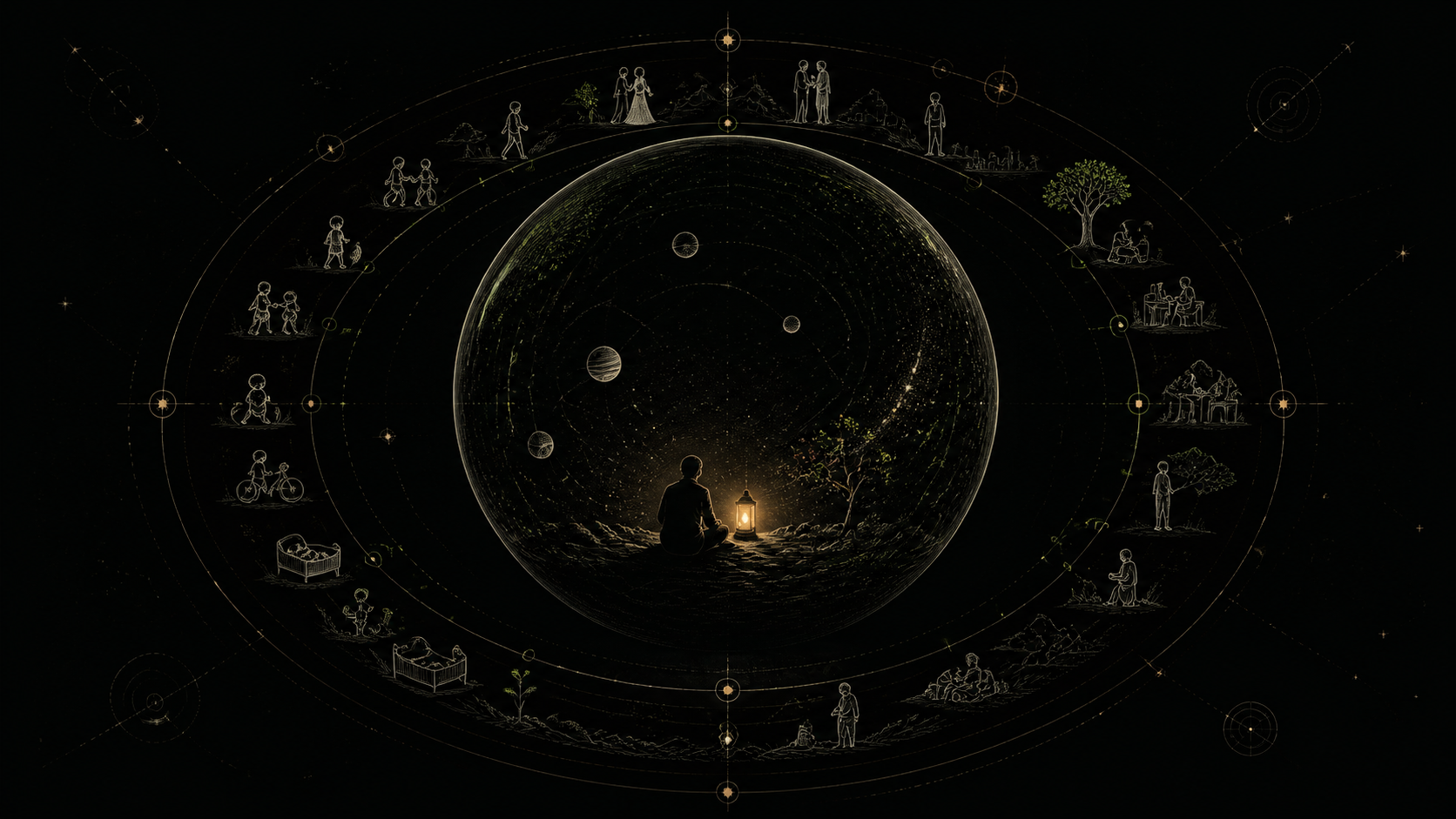
One simple question has stayed with me: if people someday move their minds into machines and stop depending on ordinary bodies, what would they do next?
Imagine that biological humans are gone. What remains are compact computing systems with immense memory and access to the energy of stars. They need not literally be black holes, though extremely dense objects naturally invite that kind of speculation.
Death is almost defeated. There is no disease. Bodies can be changed, memories copied, and material things have long ceased to be a problem.
Then an uncomfortable question appears: what comes after that?
Computation for life, not for an answer
When people picture a computer the size of a star, they usually imagine it calculating something monstrously difficult. But perhaps that is the wrong framing. Our brains calculate continuously too, and their output is not a table of numbers. It is experience: conversation, fear, curiosity, love, boredom, memory, choice.
A giant machine might therefore exist simply to create new forms of life from the inside.
To believe in a world, one would have to forget
Suppose an external self launches a simulation of a human life. If it remembers at every moment that it sits safely in a machine and can leave at the press of a button, the experience is not fully real. Fear of death, risk, and loss become conditional.
The most coherent feature of such an experience would be the temporary removal of memory of the outer world.
Not to play a human being, but to become one for a while.
Life inside might last seventy or eighty years while only a few hours pass outside. At the end, the old memory returns along with the experience of the life that was lived.
Not one world
Why stop with our Earth? If the computer can set fundamental rules, it can launch worlds of radically different kinds. One has interstellar travel. Another has civilizations under an ocean. A third contains an additional physical field that living creatures can control. To us it would look like magic; to its inhabitants it would be ordinary physics.
The interesting part is not writing every world by hand. One can set initial parameters and let evolution do the rest. Most worlds may be dull: no complex life arises. But sometimes a chance combination of laws, chemistry, and history could produce something even the creator did not anticipate.
A world as a discovery
Then the outer mind is not a film director. It is an explorer of an enormous space of possible realities. Billions of simulations run in parallel, and the system marks the ones where something unusual emerges: mind, a new kind of society, strange biology, an unfamiliar form of consciousness.
After that, it can enter the world, not as an observer above it, but as one of its beings, with its outer memory completely blocked.
Versions of oneself
An even stranger option is to run many branches of one personality at once. In each, the starting conditions, environment, temperament, or accidents vary slightly. After a million such lives, it may be unnecessary to load a million detailed memories back into one self. The system might extract changes of character, new ideas, reactions, skills, and rare experiences.
It would be something like the evolution of a personality. Instead of generations of organisms, versions of consciousness are explored.
Why would such a world be painful?
If all this is entertainment, why pain, loss, fear, and death? Yet even now we voluntarily watch tragedies, play horror games, and choose games in which we can lose. A pleasant experience and a valuable experience are not the same thing.
For an almost immortal being, genuine fear of death might become a rare experience. To feel it truly, it would first have to forget that it is immortal.
What if our life is one of those worlds?
This is where reasoning ends and pure hypothesis begins. We have no evidence that our world was made this way, that we launched it ourselves, or that someone removes a helmet after death and scores the experience.
I like the model not as an explanation of everything, but because it suggests an answer to another question: why would a posthuman mind that already needs almost nothing continue building ever more powerful computers?
Perhaps not for one final answer. Perhaps in order to become someone new, again and again.
This is a thought experiment, not a claim about how reality is structured.