Human After Humanity
Can consciousness move into an artificial body while the person remains the same?
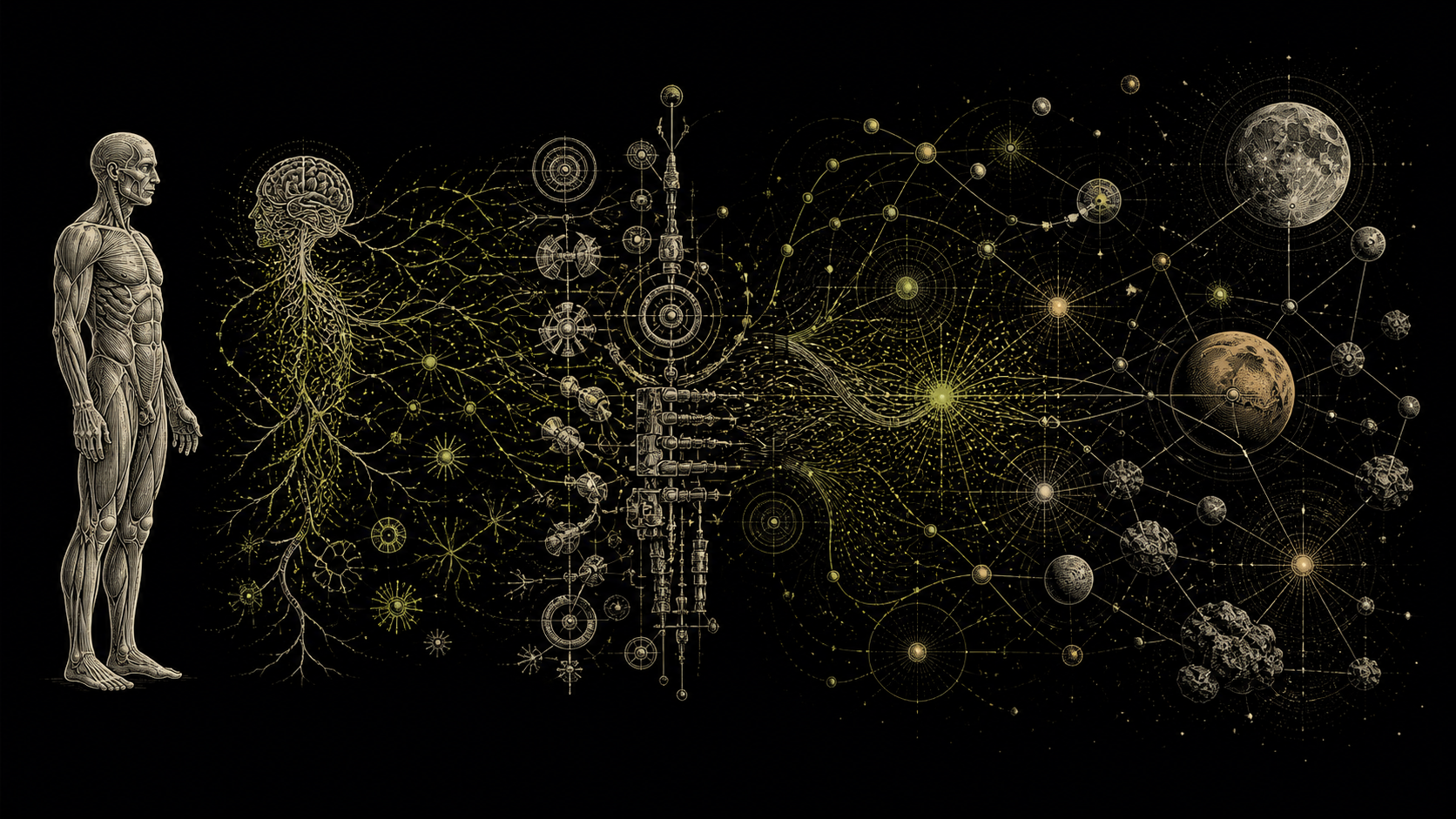
Whenever I think about space, I come back to the same thought: a human being, as a biological organism, is badly suited to distances of that scale.
We need oxygen, water, food, a narrow range of temperature and pressure, and protection from radiation. We age, get ill, and do not tolerate weightlessness well. Even a routine trip to another planet becomes an immense technical task because the ship must carry a small piece of Earth inside it.
The farther the journey, the stranger it seems to assume that human beings in their present form are the ones who must travel between the stars. Perhaps the real departure into space begins not when we build a fast enough ship, but when we begin to change ourselves.
That change will probably not be a scene in which someone lies down in a capsule and wakes up as a robot. In small ways, it has already begun. We replace body parts, use implants and increasingly capable prostheses, and learn to connect electronics to the nervous system. A portion of our memory already lives outside the brain: in phones, computers, clouds, photographs, and messages.
Once, a person had to remember information alone. Then came writing, books, and computers. Now we often only need to know where to find something. The next step may be a closer bond between brain and computer: first enhanced functions, then repairs, then perhaps replacements not because tissue is damaged, but because the artificial version works better.
That raises a question for which I do not have a satisfying answer. Replacing an arm, a heart, or even much of a body does not seem to erase the person. But what if parts of the brain are replaced gradually? Suppose an artificial part performs exactly as the biological one did: memory remains, character remains, and consciousness is never interrupted. At what point would the person cease to be human?
I wrote about a related idea in "The Metaphysics of a Self-Unfolding Mind". If a mind can create new substrates for itself, the biological brain may be not an endpoint, but one stage among others.
The gradual nature of the transition matters. A digital copy is easy to describe: I am standing here, and beside me is a copy with all my memories. It may believe it is me, but I have not gone anywhere. It is a copy. If the change happens bit by bit and the stream of consciousness never breaks, the problem becomes much harder.
Over several generations, there may be radically different descendants of what we once called human. Some may keep almost entirely biological bodies. Some may replace organs and limbs. Some may become cyborgs, some may inhabit artificial bodies, and some may no longer need one permanent body at all. They may connect to different devices when they choose.
Then the word ‘human’ may slowly lose its sharp boundary. There could be androids, cyborgs, virtual persons, and forms of mind for which we do not yet have a useful name.
It becomes even more interesting if a mind is no longer tied to one body. We are used to a simple pattern: one person, one body, one brain, one consciousness. But that is merely our biology. A mind implemented in a computational system might be distributed across several devices. One consciousness could control several bodies; several minds could temporarily combine.
Imagine ten distinct people, each with their own memories and character, pooling part of their memory and thought when necessary. At that moment are they still ten beings, or does one larger mind appear? If they remain joined for years and then separate, who owns the shared memories?
Perhaps the ordinary idea of a person will change. There may be minds that are separate at one moment and join into something like a swarm at another—not an insect swarm where an individual counts for almost nothing, but a system in which persons preserve themselves while becoming part of a larger consciousness when needed. It would be something strange between ‘I’ and ‘we.’
For space, such a form of life seems far more practical than a human body. A machine need not keep consciousness fully active all the time. If a ship travels for a century, the mind could be slowed down or switched off for most of the journey. For a human, a hundred-year flight is almost an impossible problem; for a computational system, it may be waiting time. Consciousness wakes, checks the ship, and sleeps again. Subjectively, the journey might last only a few hours.
There may be no need to transport full bodies at all. An automated craft could reach another system, find raw materials, build energy and manufacturing facilities, assemble computational systems, and only then start the stored persons. What crosses space would not be a human being, but information about a human—or about a being descended from humanity.
The same changes matter in a global catastrophe. As a biological species, we depend enormously on conditions on a few planets, and in practice on one. A distributed machine civilization could exist on Earth, the Moon, Mars, asteroids, and in other star systems. It might lose one part of itself while the others continue. In that sense, mind could become much more resilient than biological life.
Still, there is a strange thought here. Suppose humanity really follows this path. A million years from now, distributed artificial minds move through space. They change bodies, join and divide, copy themselves, slow their thinking, and live for millennia. Will they be human? Probably not. Yet they will have come from us.
Humanity may disappear while continuing to live. There need be no final day of humanity; each generation simply becomes a little different, then different again, until the gap between us and our descendants is as large as the gap between us and remote ancestors. The difference is that natural selection once did this alone. Now mind may begin to alter itself deliberately.
Perhaps a human being is not the final form of intelligent life. Perhaps humanity is the moment when biological evolution first produced a being able to choose what it will become next. But another question remains. Suppose it works: we escape fragile bodies, ageing, and disease; we live for thousands of years, change bodies, and build any virtual world we want. Why live at all? To me, that question is harder than the transition into a machine itself.