If worlds can be created, why create only one?
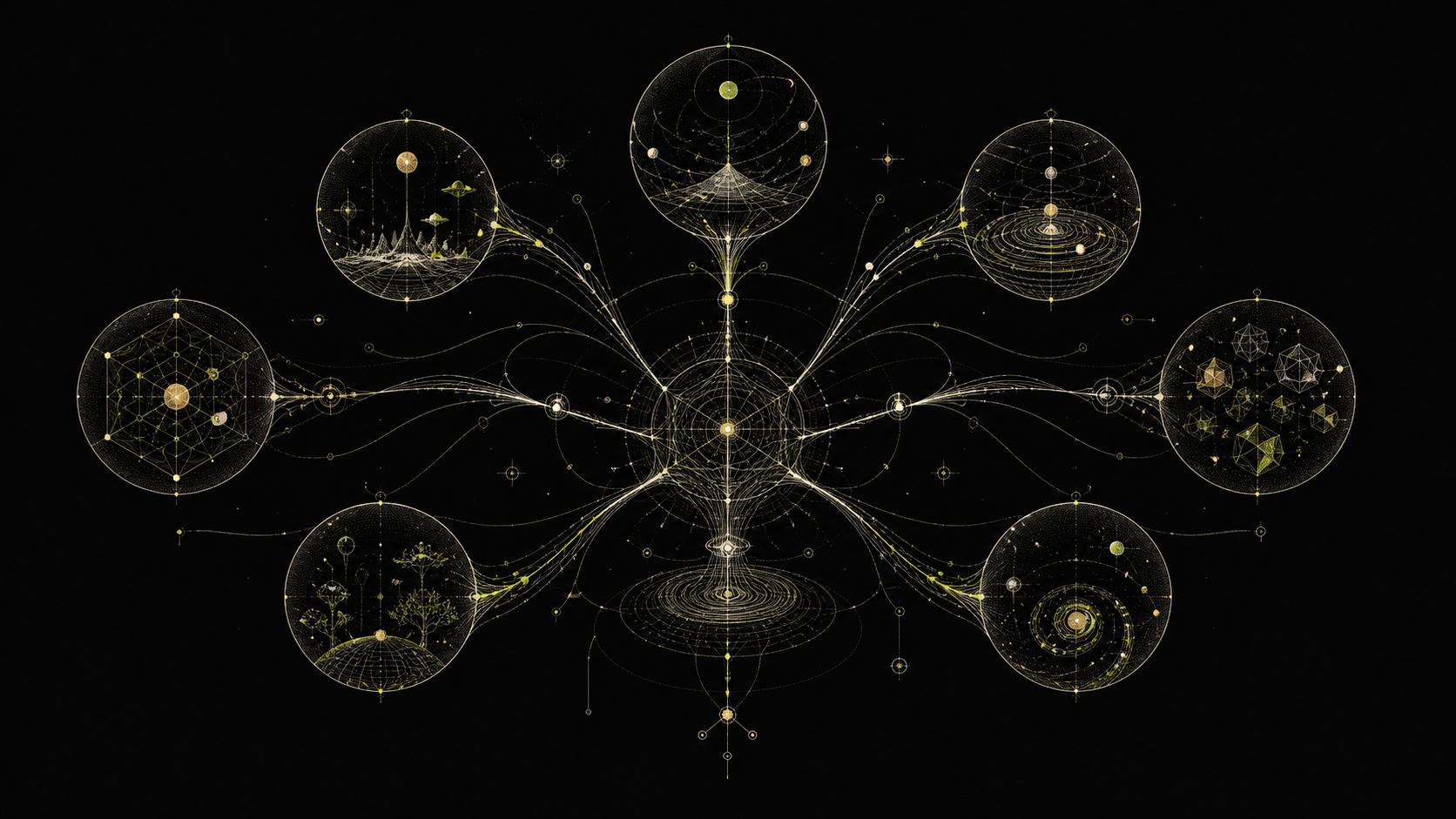
When I think about simulation, I like less and less the idea that someone simply created our Earth, our history, and our laws of physics.
If a computer can model complete worlds with conscious beings, why should it be limited to one universe?
It is more interesting to imagine a generator of possible realities. Our world could be one particular option among an enormous number of others: one seed, one combination of parameters, one of the worlds that managed to arise.
There is no need to copy our physics
An external computer could change the number of spatial dimensions, gravity, the speed of light, elementary particles, complex matter, biology, or the conditions for life.
It could add a physical field (M) that some nervous systems can influence. One organism could heat matter through it, another could move objects, and a third could sense the space around itself.
To us, such a world would look like fantasy: magic, telekinesis, spells. To its inhabitants it would simply be physics. They could study the field, discover conservation laws, calculate its range, and understand its limits. A fantasy world does not need to break physics. It can run on different physics.
The world does not have to be designed by hand
If a creator writes every king, war, dragon, hero, and civilization in advance, the result is a very complicated film. A more interesting option is to define only rules, parameters, and a random initial state, then start the process.
Uᵢ = F(Pᵢ, Sᵢ)
Most of a trillion attempts would probably produce nothing interesting. One universe collapses, another cannot form stable atoms, another is almost empty, and another never develops complex chemistry.
But sometimes a sequence may appear:
physics → chemistry → self-replication → evolution → mind → civilization
The valuable part is that the creator does not know in advance what will result. The simulation becomes an experiment with an unknown outcome, not a film whose plot is already known.
To enter a world, not just observe it
Imagine a system constantly searching through worlds. After launching 10¹² universes, it reports: Universe 847 194 016 — complex intelligent life detected.
The external mind can open that world and watch it. Or it can do something stranger: enter it. It chooses one inhabitant, blocks its memory of external reality, and is born inside. The next seventy years are completely real to it.
In one simulation it is a human of the twenty-first century. In another, a citizen of a space civilization. In a third, a being from a world we would call magical. In a fourth, an organism of an entirely different nature.
Many lives in parallel
Why wait for one simulation to end? One external mind can create many branches:
A → A₁, A₂, A₃, …, Aₙ
One branch lives in a space empire, another in a medieval world, another underwater, another in a body humans could not imagine, and another on Earth. All these lives run in parallel.
Loading a million complete biographies back into the original mind could destroy its identity. Full memories may not be necessary. Each life can leave concentrated results: skills, emotional reactions, solutions, character changes, ideas, and rare experiences.
10⁶ lives → experience extraction → updated mind
We already resemble this a little. I do not remember every second of my first five years, but those years still formed me.
The external mind evolves too
Biological evolution follows mutation → organism → life → selection. A post-biological mind could run variation of personality → a million lives → analysis → integration.
Millions of subjective generations could pass during one external day. Over time, such a mind might differ from its human ancestors as much as we differ from simple organisms, while still remembering where it came from. It may want to become human again precisely because human life is imperfect and limited.
The evolution of worlds
Why should the creator choose every law by hand? It could evolve the physical rules themselves. Start with one set of laws, create a universe, measure what it produces, and change the parameters:
Pᵢ → Pᵢ + ΔP
Then start the next world. After enough generations, worlds themselves evolve. Systems may select for complexity, diversity, minds, unusual consciousness, new civilizations, strong experiences, and unexpected structures.
Our universe, if we follow the thought experiment, might be the descendant of billions of previous worlds. Even its creator might not know why the laws have exactly these values. The answer could be like the answer to why the human eye has its particular form: not because an engineer drew it at a desk, but because a long history of change and selection produced it.
Usually we imagine a programmer who wrote a world. Here the programmer creates only the mechanism that gives birth to worlds, and then does not know what will appear.
Perhaps the greatest value is not an ideal world, but conditions in which something can arise that the creator could never have invented. This is only a thought experiment. We have no reason to believe our universe appeared this way. But a mind with almost unlimited computing power might eventually use it not just for calculations, but to create new ways of existing.