Dreaming as a Built-In Simulation of Reality
Why does the brain build a convincing world every night, and could dreams become controlled simulations?
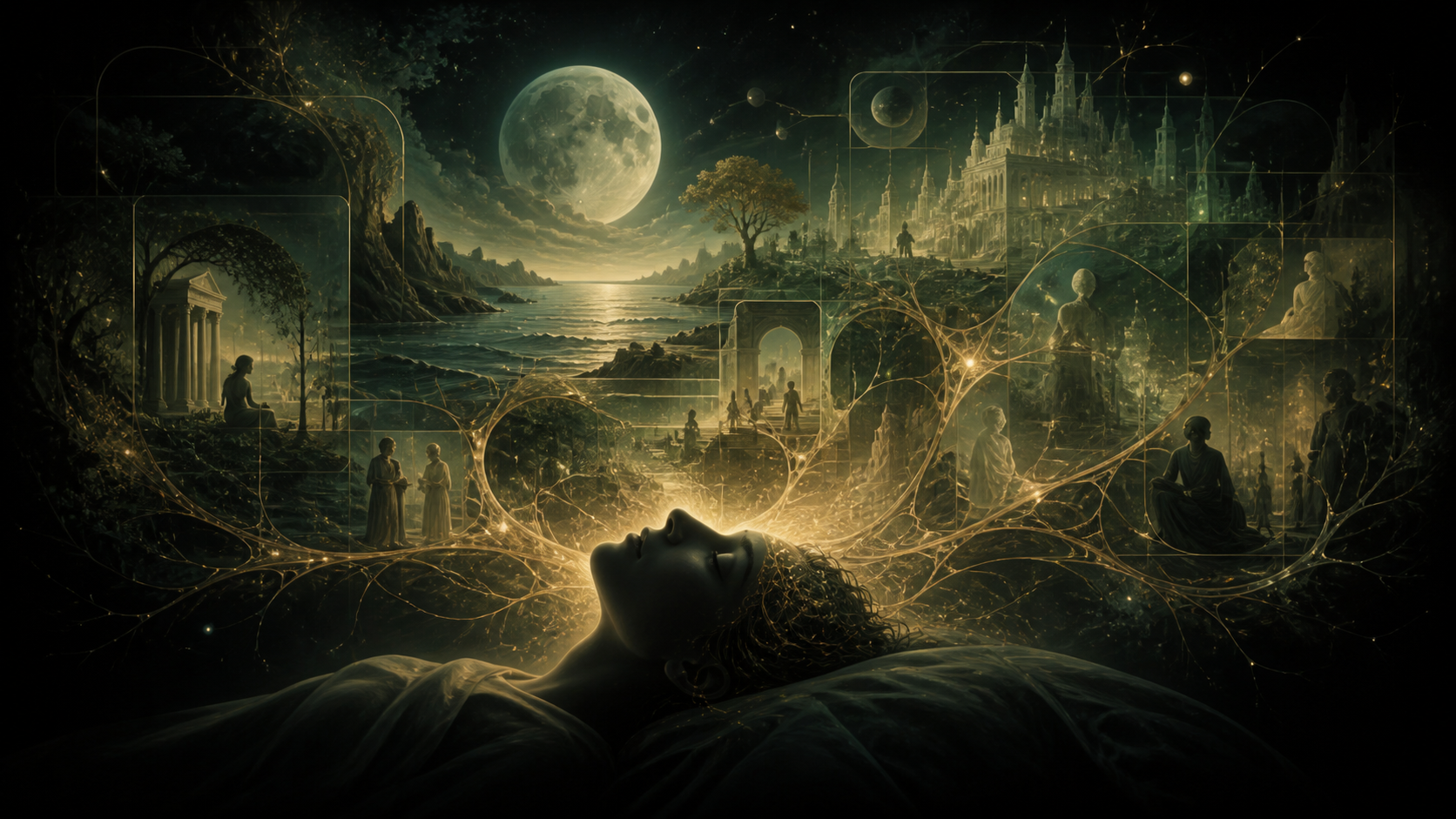
Every night, your brain proves that it can convince you of the existence of a world that is not there.
In a dream, I can find myself in a house that never existed. I can talk to someone who has not been around for a long time. I can run from someone, feel fear, and see skies, streets, rooms, and faces.
And the strangest thing is that most of the time I do not ask myself: “Is any of this real?”
I simply accept that world.
Until I wake up.
That moment becomes slightly unsettling when you think about it. It means the brain does not necessarily need a real world coming from outside in order to create the feeling of reality for me.
It can make reality itself.
We already know how to live inside a simulation
When people talk about the virtual reality of the future, they usually imagine headsets, screens, neural interfaces, and some kind of implants.
But perhaps the most advanced virtual reality generator is already inside our heads.
In a dream, no real light from the building I see reaches my retina.
There is no actual person standing in front of me.
There is no real space for me to walk through.
And yet I still see.
I hear.
Sometimes I feel touch, pain, cold, fear, and pleasure.
What is more, a dream can contain something resembling a past. I may “remember” why I arrived somewhere even though that past never happened.
The brain can therefore create more than an image of the surrounding world.
It can create the context of that world.
And that is much more interesting.
Reality, after all, is not merely a picture in front of our eyes.
It is the sense that what is happening has a history, causes, and a continuation.
Where is the boundary between a dream and a simulation?
An ordinary dream is chaotic.
We have almost no control over its beginning, plot, duration, or content.
But imagine that one day people learn to control those parameters.
Not merely to become aware of themselves in a dream, as in lucid dreaming, but literally to specify its conditions.
For example:
I want to be by the sea;
let it be evening;
I want to spend several days there;
certain people will be nearby;
I will remember why I came;
the world must remain stable and logical.
What would that be?
A dream?
Virtual reality?
A simulation?
The distinction between those words would probably begin to disappear.
The most interesting part is time
Dreams can sometimes produce the strange feeling that many events have taken place even though very little time has passed in the waking world.
This does not necessarily mean that the brain experienced several days there second by second.
It may simply know how to create a sense of duration.
And this is where a much more interesting fantasy begins.
What if one day we learn to control subjective time artificially?
Suppose a person sleeps for eight hours.
But subjectively, a day passes.
A week.
A month.
How far could the inner sense of time be stretched?
I do not know.
The brain may have very strict limits on how much information it can process.
But the possibility alone is enough to make you wonder.
Because then dreaming stops being merely a form of rest.
It becomes an additional space for living.
Can an artificial dream be created?
I do not mean a pill that makes someone fall asleep.
I mean a system capable of controlling the content of a dream.
Suppose a neural interface monitors the state of the brain and gradually learns which processes correspond to images, emotions, and the feeling of space.
The next step would be not only to read them, but to intervene.
Very crudely at first.
To evoke the sensation of light.
Of sound.
Of someone’s presence.
Then a single image.
A room.
A landscape.
And eventually, perhaps, an entire stable environment.
There may be no need to generate every object directly.
Our brains are already remarkably good at completing reality.
Perhaps they only need to be given a direction.
Like a generative system.
Instead of drawing every blade of grass, you say: there is a field here.
And the brain fills in the rest.
Then the computer would create not the world, but the conditions for it to emerge
This seems like an important distinction to me.
Today, a computer renders a virtual world itself.
It calculates geometry, light, physics, and sound.
A person views the result through a screen.
In an artificial dream, the arrangement could be reversed.
The computer would not have to model the surrounding reality in full.
It might only guide the brain.
The brain itself would create the subjective world.
The result would be a strange hybrid.
Part of the simulation would run on a machine.
Part of it would run inside a person.
And that may be why such a technology could one day become far more convincing than any screen.
The brain would not need to be told that it was looking at virtual reality.
It would be producing that reality itself.
What if artificial intelligence were added?
Then things become even more interesting.
AI could manage such a world in real time.
It could create characters.
Change events.
Remember what had happened before.
Adapt to the person inside it.
Suppose I wanted to see what the world would look like if the Roman Empire had never fallen.
Or live on another planet.
Or see Earth a thousand years from now.
I would not merely watch a film.
I would be inside that world.
I would talk to its inhabitants.
Explore it.
And no one would know in advance what would happen next, because the world would be generated while the dream itself was taking place.
In essence, it could become something like an endless game, only without a screen.
But this raises an unpleasant question
If such a simulation became convincing enough, why leave it?
Real life has limits.
You have to work.
You can become ill.
You can lose someone close to you.
You can live an entire life without ever getting what you wanted.
An artificial world, meanwhile, could be built around you.
Want to travel? Travel.
Want to live another life? Live it.
Want another world? Here it is.
The problem of the future may not be that virtual worlds are insufficiently realistic.
It may be the opposite.
They may become too good.
Although there is an even stranger thought
We are used to calling dreams unreal because we wake up from them.
But while we are inside a dream, that distinction often disappears.
So what makes reality real to a conscious mind?
Is it the fact that reality exists independently of me?
Or the fact that I can experience it?
Of course, there is an enormous difference between the waking world and a dream.
The waking world is stable, shared with other people, and continues to exist independently of my perception.
A dream is a product of my brain.
But for subjective experience itself, the boundary can sometimes be surprisingly thin.
The brain takes the world it creates seriously.
The heart races because of an imaginary danger.
We feel real sadness for a person who does not exist.
We wake up frightened by an event that never happened.
The event was not real.
The experience was.
And this is why an artificial dream is much more interesting to me than ordinary virtual reality.
It makes us think about more than the technologies of the future.
It makes us ask:
how much reality does consciousness need before it decides that it is alive?