If we live in a simulation, is there a real world at all?
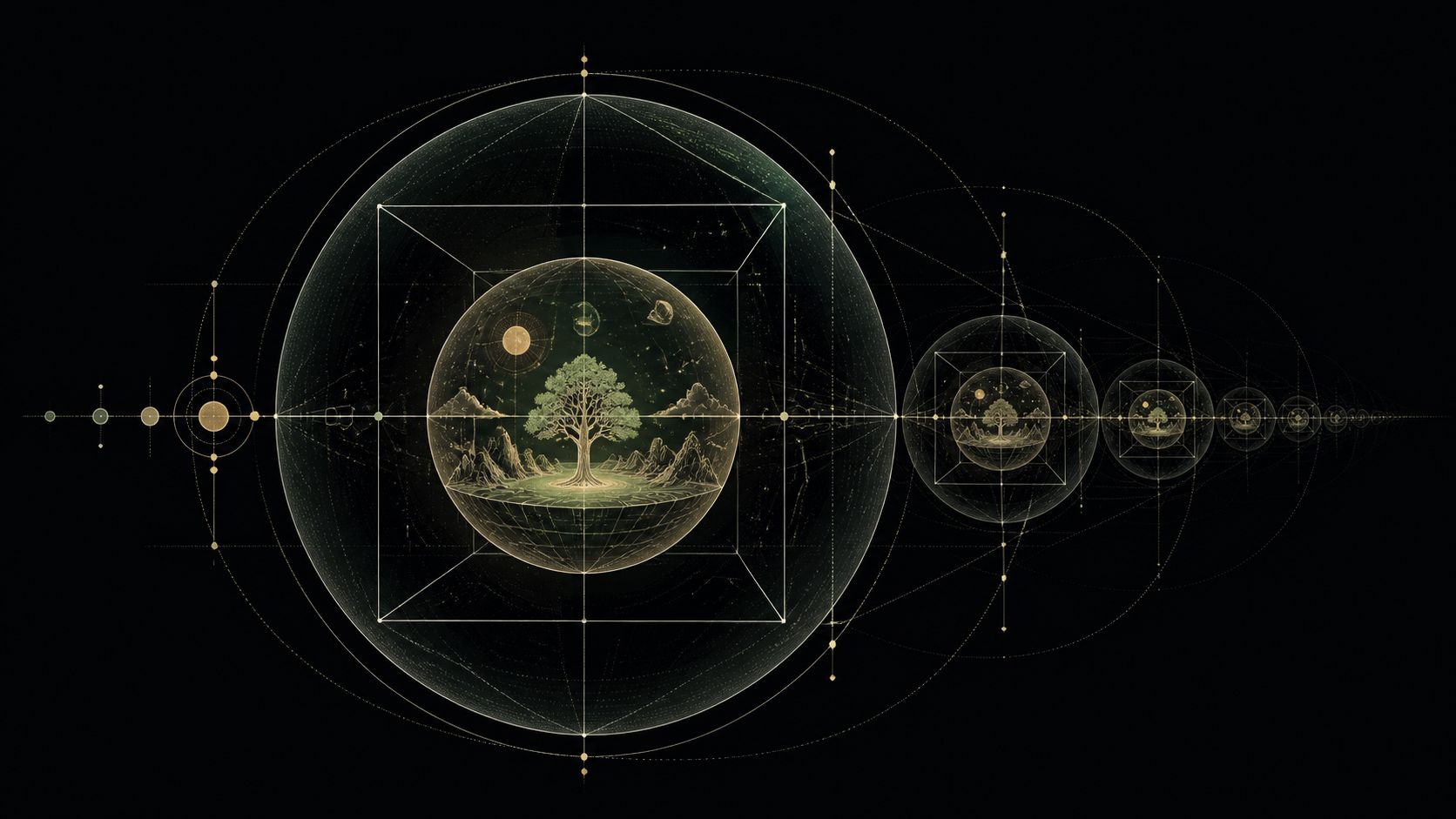
Sometimes I think: if our world really is a simulation, why should I assume that the world simulating us is already “real”?
After all, it too could contain a civilization that eventually reached technologies allowing it to create its own simulations. Which means that their world may also have been started by someone else.
And then we get a chain:
R₀ ← R₁ ← R₂ ← R₃ ← …
Every world looks completely real to those inside it. There is matter, time, memory, death, and physical laws. Yet the entire world may exist inside a system one level above.
The simplest option is that there is a base reality somewhere. A genuine bottom level that nobody simulates.
It creates the next world. That world creates another. Then another.
In that case, the chain is finite.
But why must it be finite?
It is possible to imagine an infinite sequence of worlds, where each level is a simulation of the next. In such a system there is no final floor about which one can say: “now we have finally reached reality.”
And I think this begins to change the question itself.
We are used to asking:
which of these worlds is real?
But perhaps the better question is:
which level are you on right now?
For a being inside a simulation, its world does not become unreal merely because a higher level exists somewhere.
If I am in pain, that pain is real.
If I love something, that experience is real.
If the physical laws of the world are stable, I can study them.
Subjectively and causally, this world remains reality.
There is an even stranger possibility.
Suppose the levels do not form a straight chain at all.
One advanced civilization may launch a million worlds. In some of those worlds, civilizations will appear that also learn to create simulations. Each of them will launch millions more.
Then it is no longer a staircase, but a giant tree.
One world gives birth to thousands of others.
Those give birth to thousands more.
And the number of simulated civilizations begins to grow very quickly.
Here an interesting statistical point appears.
If advanced civilizations really do often launch enormous numbers of worlds with conscious beings, then at some point simulated observers may greatly outnumber beings from the original reality.
So if we choose a random intelligent observer from the entire system, the probability that they are in the base world may be very small.
This is roughly where Bostrom’s well-known simulation argument comes from.
But an infinite chain creates another problem.
Resources.
If the computer of one world simulates another computer, and that computer simulates the next one inside itself, the question is: where does the computing power come from?
computerₙ → simulates computerₙ₊₁ → that one simulates n+2
If every next level must be equally complex and run at the same speed, infinite nesting begins to look problematic.
But the speed of time does not have to match.
For beings inside a simulation, billions of years may pass while only a few hours pass at the outer level.
The next level may run even more slowly.
Then the depth of the chain can be enormous, even if the computing resources of each upper world are limited.
Although I suspect we are taking the word “simulation” too literally here.
We immediately picture a computer.
A machine somewhere, a program inside it, and a world inside the program.
But what if that is not how it works?
Perhaps one level of reality gives rise to another not in the way an ordinary computer launches a game.
Maybe a fundamental mathematical or informational structure can give rise to another self-sufficient structure.
It might look more like this:
structure → self-sustaining world → new structure
In that case, the idea of infinitely many levels no longer seems so absurd.
There is an even stranger option: a closed cycle.
World A creates world B.
World B eventually creates world C.
And world C somehow becomes the cause of world A appearing.
Then the first creator disappears entirely.
Just as a circle has no point that geometry itself must treat as its beginning, a chain of realities may have no first world.
At this point, the question “who created all of this?” stops having an obvious meaning.
Perhaps there is no final author.
No main computer.
No room where the one truly real person sits and watches a monitor.
There may only be a network of causally connected worlds.
Each is real for the beings inside it.
Each can give rise to new worlds.
And if we someday create a complete simulation with beings that possess consciousness and consider their world real, then we will become that external level for them.
They will be able to argue:
are we living in a simulation?
And one of them will surely say:
if we were created, then who created our creators?
At that very moment, we may be asking the same question about our own world.
And then a rather strange picture emerges.
Perhaps “real reality” is not a particular floor at all.
Perhaps reality is the entire infinite structure.