Can You Upload Your Mind and Still Be You?
Mind uploading, personal identity, and the problem of digital immortality
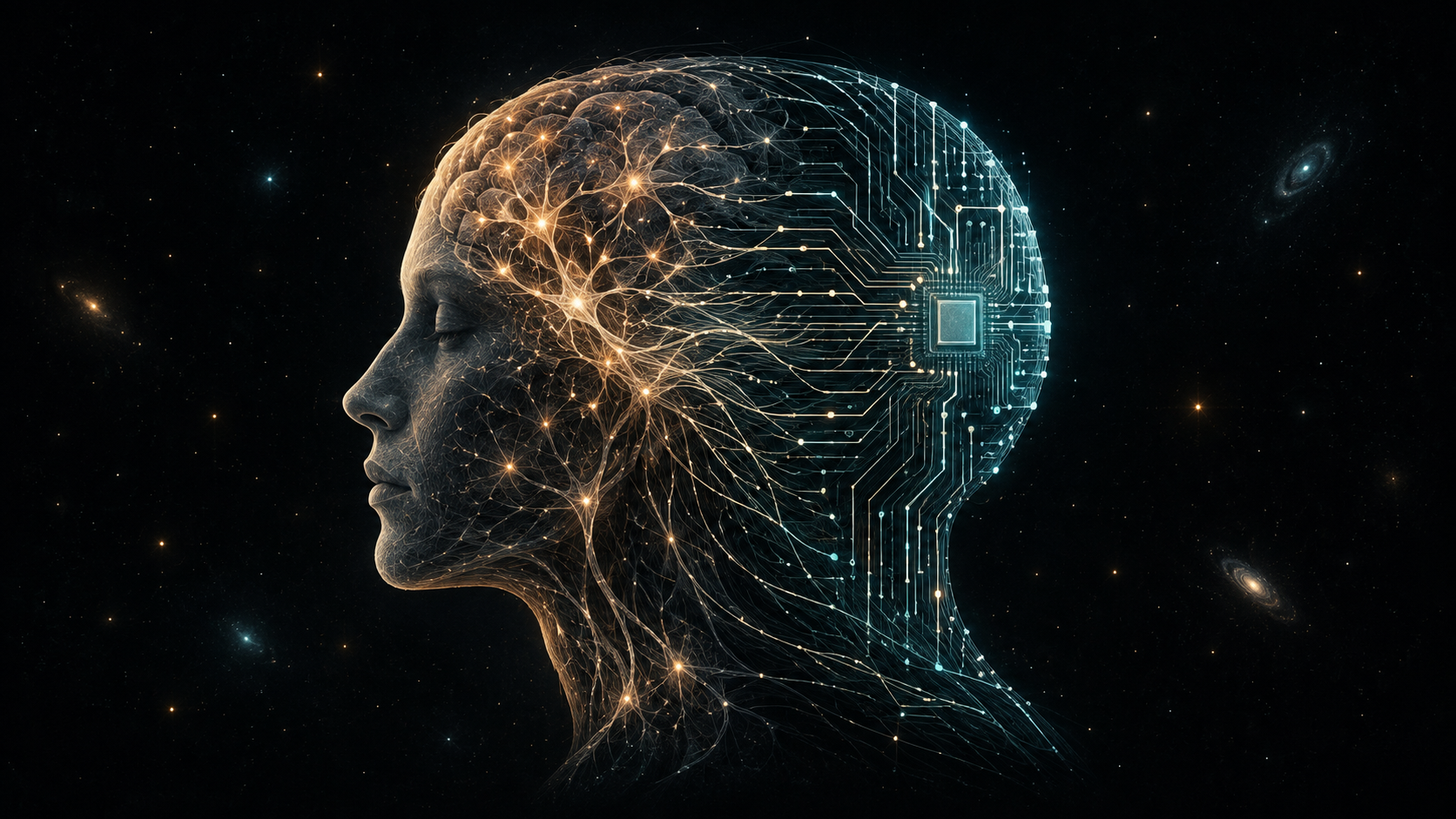
When a human being dies, most of the matter that made up that person does not suddenly disappear.
The brain is still there.
The neurons are still there.
The atoms are still there.
And yet the person is gone.
That suggests something strange about death.
Perhaps death does not primarily destroy matter.
It destroys — or irreversibly disrupts — a particular organization of matter that was continuously maintaining itself.
And if a person is, at least in part, a dynamic information process occurring inside the brain, an obvious question follows:
Could we preserve that process?
This is where ideas such as mind uploading, consciousness transfer, whole brain emulation, and digital immortality enter the conversation.
The usual proposal sounds straightforward.
Scan the brain in sufficient detail.
Reproduce its neurons, connections, memories, and internal states.
Run the resulting structure on another substrate.
The machine wakes up.
It remembers being you.
Problem solved.
Except there is a much deeper problem.
Why should the copy be you?
A perfect copy may still be a different person
Imagine a future machine capable of scanning my brain with extraordinary precision.
It reconstructs my memories, personality, preferences, fears, neural connections, and everything else required to reproduce my behavior.
A digital brain is created.
It wakes up.
It remembers my childhood.
It remembers writing this article.
It remembers entering the scanner.
Ask it who it is, and it will answer without hesitation:
“I am me.”
From the outside, this might look like successful consciousness transfer.
But there is a simple experiment that makes the problem obvious.
Do not kill the original.
Leave the biological person alive while the uploaded mind begins running.
Now there are two of us.
Both remember the same childhood.
Both claim to be the original.
Both have exactly the same subjective history up to the moment of copying.
But from that moment onward, they see different things, think different thoughts, and accumulate different memories.
They become two people.
Nothing was transferred.
A second branch was created.
That makes the promise of digital immortality much less obvious.
Perhaps ordinary mind uploading does not save you.
Perhaps it creates an extraordinarily convincing descendant who remembers being you.
The copy may believe you survived.
Everyone around it may believe you survived.
But that does not answer the question that matters from the first-person perspective:
Will you be the one who wakes up?
Maybe information is not enough
We often talk about a person as though the mind were a collection of information.
Memories.
Personality.
Knowledge.
Neural connections.
But a human mind is not a frozen brain state.
It is a continuously changing process.
We could describe it abstractly as:
Self₀ → Self₁ → Self₂ → Self₃ → Self₄…
The version of you that began reading this paragraph is already slightly different from the version reaching its end.
Signals have moved through your brain.
New memories have formed.
Synapses and chemical states have changed.
Yet we do not say that you die every fraction of a second and are replaced by a new person.
Why not?
One possibility is that every new state is causally produced by the state immediately before it.
There is no break.
And if that continuity matters, preserving a person might require more than preserving information.
We may need to preserve the chain itself.
What if we replace the brain gradually?
This leads to a very different version of mind uploading.
Imagine that one day we can build an artificial neuron capable of performing all the relevant functions of a biological neuron.
It receives signals.
Changes its internal state.
Adapts.
Communicates with surrounding neurons.
Now replace one biological neuron.
Did you die?
Probably not.
Replace ten.
A thousand.
A million.
A billion.
At exactly which neuron do you stop being you?
This is the Ship of Theseus problem applied to consciousness.
In the ancient thought experiment, parts of a ship are replaced one by one.
Eventually, none of the original material remains.
Yet the ship was never destroyed and reconstructed elsewhere.
It simply continued while its material changed.
What if the brain could undergo the same transformation?
A biological brain could become an artificial brain without being switched off
Imagine the process more carefully.
An artificial neuron is not immediately substituted for a biological one.
Instead, it is connected alongside it.
For some period, both participate in the same network.
The artificial system learns how the biological neuron responds to its inputs and how it influences surrounding cells.
Only after it has become integrated into the ongoing process is the original neuron gradually removed from that role.
The brain never completely stops functioning.
Then the same procedure happens again.
And again.
Years pass.
A significant part of the brain is now artificial.
Yet the person can still talk.
Remember the beginning of the procedure.
Learn new things.
Experience the transition.
Eventually, only a small amount of biological neural tissue remains.
Then the final biological neuron is replaced.
The brain is now completely synthetic.
So when did the original person die?
After the first replacement?
After a million?
When half of the neurons were artificial?
At the final neuron?
If there was never a point at which the functioning system was destroyed, identifying a moment of death becomes surprisingly difficult.
And this may be the crucial difference between copying a mind and continuing a mind on a different substrate.
Maybe consciousness should never be “transferred” at all
The phrase consciousness transfer may itself be misleading.
It makes consciousness sound like a file:
brain → copy → computer.
But perhaps there is no consciousness file waiting inside the brain to be extracted.
There is only an ongoing process.
If so, the real technological challenge would not be transferring consciousness between two machines.
It would be:
changing the machine while the process continues running.
Instead of:
biological person → destruction → digital person
we would have:
biological person → partly synthetic person → mostly synthetic person → fully synthetic person.
There is no second instance.
There is no moment when the original is shut down and another version booted.
There is simply:
A → A₁ → A₂ → A₃ → A₄…
We would not copy the river.
We would gradually change its riverbed while the water continues to flow.
But consciousness already disappears when we sleep
There is an obvious objection.
We lose ordinary conscious awareness every night.
General anesthesia can also produce periods in which there appears to be little or no conscious experience.
Yet when someone wakes up, we normally consider them the same person.
This suggests that continuous conscious experience may not be necessary for personal survival.
Something else may matter more.
The physical and causal system remains present.
The sleeping brain is not destroyed and reconstructed from a scan in the morning.
Later brain states emerge from earlier brain states through an unbroken physical history.
So we should distinguish two different ideas.
Continuity of consciousness means that subjective experience itself never stops.
Continuity of personal identity means that later states remain causally connected to earlier states of the same system.
The second may be far more important than the first.
There may be another requirement: no branching
Suppose we have:
A → B
but also:
A → C.
B and C have identical memories at the moment they are created.
Both remember being A.
Yet one second later they are separate observers.
That makes it difficult to argue that both are the single future continuation of the original person.
A theory of personal continuity based on this idea might therefore require at least three things.
Causal continuity. Every new state must arise directly from the previous state.
Gradual transformation. The functioning system changes rather than being completely destroyed and recreated.
No branching. There is one continuing history instead of multiple independent copies.
None of these conditions has been proven to be sufficient for preserving subjective identity.
That is important.
This is a philosophical hypothesis, not an established law of neuroscience.
But it changes the way we think about digital immortality.
Whole brain emulation does not automatically solve personal identity
Whole brain emulation is the hypothetical project of reproducing the relevant structure and function of an individual brain on another computational substrate.
It is one of the main technical ideas associated with mind uploading.
But even a technically perfect brain emulation would not automatically answer the identity question.
A simulation could behave like you.
Remember being you.
Love the same people.
Recognize the same places.
Finish your unfinished sentences.
And still leave one question unresolved:
Is this a continuation of your consciousness or a new consciousness carrying your memories?
Technology could potentially solve the engineering problem long before philosophy and neuroscience solve that one.
How could we ever test whether “you” survived?
Imagine that gradual neural replacement eventually becomes possible.
Years later, the last biological neuron is replaced.
The person looks at us through an artificial body and says:
“I remember the entire process. I never disappeared. I am still me.”
What measurement could prove that statement?
We could test memory.
Personality.
Intelligence.
Behavior.
Neural dynamics.
We could compare the system before and after the transition.
But none of those measurements obviously tells us whether the same first-person observer continued through the transformation.
There is currently no known instrument that displays:
Original subjective identity: preserved.
This may be one of the deepest problems facing any serious concept of mind uploading.
Digital immortality may look nothing like science fiction
We often imagine mind uploading as a dramatic event.
A person enters a machine.
The brain is scanned.
A computer switches on.
The person wakes up in a digital world.
But if continuity matters, genuine digital immortality may look almost nothing like that.
The transition could take years.
Artificial structures might first compensate for damaged neural circuits.
Then extend memory.
Then replace small functions.
Then larger networks.
The boundary between biological and artificial cognition could slowly disappear.
Eventually, a person born with a biological brain might contain none of the brain tissue they were born with.
And yet there might never have been a moment when that person died.
Perhaps immortality is not about copying information
If personal identity is information, then preserving information sounds sufficient.
But perhaps a person is not merely information.
Perhaps a person is the history of information transforming itself.
Not a photograph of a whirlpool, but the whirlpool continuing to turn.
Not a recording of a flame, but the fire itself continuing to burn.
Not the source code of a program, but one particular execution of that program extending through time.
If that is true, the central problem of immortality changes completely.
We may not need to discover how to copy a human being perfectly.
We may need to discover how to change the substrate of a human being without breaking the causal process that constitutes that person.
Then the most important question about the future of consciousness is no longer:
Can we upload the human mind to a computer?
It becomes:
Can a biological brain gradually become non-biological without there ever being a moment when the person stops being themselves?
If the answer is ever yes, digital immortality may not require resurrection after death.
It may require avoiding that break in the first place.